Charlett Wenig
 Privat
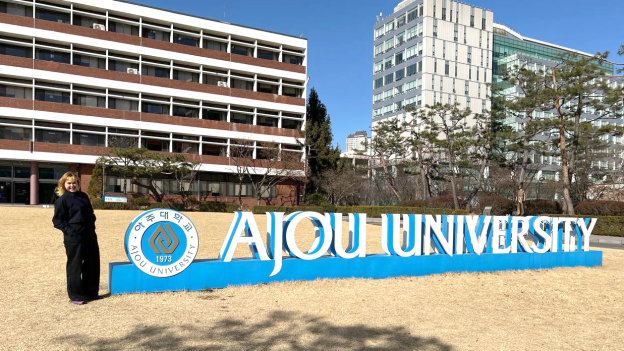
In front of Ajou University
“Thanks to the financial support of the DAAD-Stiftung, I had the opportunity to carry out a research visit at Ajou University in Suwon, South Korea. The stay was highly enriching for me on both an academic and a personal level. Alongside the work on my research project, I was able to establish new research contacts, gain insights into university practices in South Korea and further develop my own research approach within an international context.”
As part of the KSB Stiftung Scholarship of the DAAD-Stiftung, Dr. Charlett Wenig spent several months at Ajou University in Suwon. Beyond her actual research work, in which she laid important groundwork for the further development of bio-based material systems, it was above all the warmth and small, everyday gestures of the people she met that shaped her experience. At the same time, the close exchange and collaboration opened up new methodological perspectives for her and gave her a deeper understanding of academic life in South Korea.
My research stay centred around the investigation of biological short-fibre systems and their potential for scalable material systems. The starting point was the question of how heterogeneous, short and difficult-to-control fibres could be used as the source material for new, adaptive and architecturally relevant material systems rather than being viewed as waste products.
I am currently a materials researcher and designer at the Max Planck Institute of Colloids and Interfaces (MPIKG), where I work in the area of basic research on biomaterials. Prof. Kwon and I already know each other from his time at the MPI, but this was our first opportunity to engage in research together. His move to Ajou University, an application-oriented engineering university, opened up the opportunity to effectively combine our respective areas of expertise.
The focus of our collaboration lay on the question of how locally available, keratin-based fibres, which would otherwise be handled and disposed of as waste products, could be turned into a source material for scalable material systems. We were interested in an approach that is in principle transferable: taking up locally available animal raw material and embedding it in larger, globally relevant circular material flows.
Privat
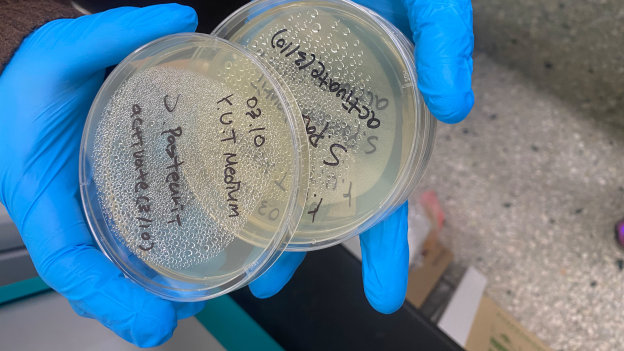
First bacterial cultures
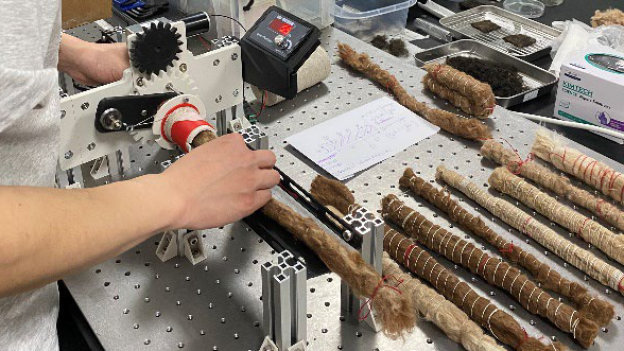
To this end, we combined textile processing methods with bio-based material engineering. On the one hand, the fibres were mechanically pre-structured, compacted and processed through a coiling machine developed by me to produce cohesive semi-finished products. On the other hand, initial attempts at mineralisation were undertaken, in particular with the help of a microbially induced calcite precipitation, or MICP.
During my stay, it became apparent that process parameters such as winding tension, fibre density, winding angle, and compression force have a clear influence on the stability, density distribution and geometry of the resulting structures. The initial calcification attempts also suggest that the fibres utilised could have potential for mineral deposition. The investigations are not yet completed, but they already offer a valuable foundation for the further development of bio-based material systems.
The application possibilities for these biological composites open up perspectives for sustainable façade structures and architectural surfaces. As both architecturally-relevant material research and microbiology are highly dynamic fields, it is certainly conceivable that such bio-mineral approaches could have an impact on the appearance of our built environment over the long term.
Privat
Coiling parameters
A number of important results were obtained that will be valuable in my continued research. The processes established in Korea have found their way into my guest professorship at the Bauhaus-Universität Weimar in the faculty of product design. Based on the approaches developed there, I am designing a course in which students work with textile structures and investigate which application scenarios could arise through bacterial processes and mineralising methods.
The cooperation with Ajou University is also still ongoing. In weekly online meetings, we are planning the next steps, including further material characterisation efforts, mecha-nical tests and a joint publication.
The work at Ajou University was characterised by an atmosphere of openness, focus and, at the same time, genuine warmth. Although South Korea is highly active and well networked internationally, Ajou University, located one hour from Seoul, proved to be a university with a largely national character. Very few international students were present, and as an engineering university, the proportion of female students was also very low. This contrasted strongly with my regular experience at German research institutions.
Privat/iStock
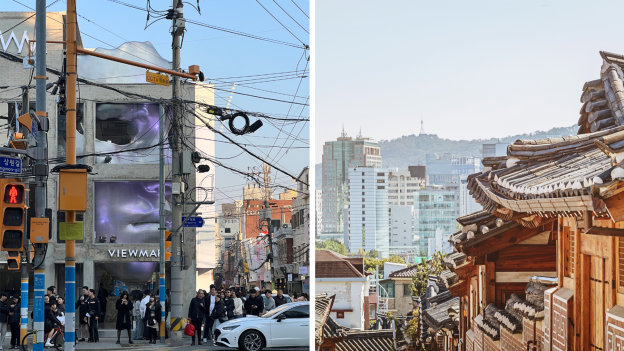
Seoul
I found the intensive exchanges with local students and researchers particularly enriching. We presented our work progress to each other in weekly meetings, which led to many enthusiastic discussions. Although English was the official working language, I quickly ascertained that the solid English skills of the members of my research group represented an exception.
English was hardly used in general daily life at the university, which is hardly surprising given the enormous linguistic distance between German and Korean. As I myself did not progress during my stay beyond a few basic expressions such as ‘thank you’ and ‘hello’, I can easily understand how difficult it is to learn so foreign a language as English.
Even outside of the formal meetings, there were continual academic and personal exchanges, often during a shared lunch or, when the work days grew long, over supper.
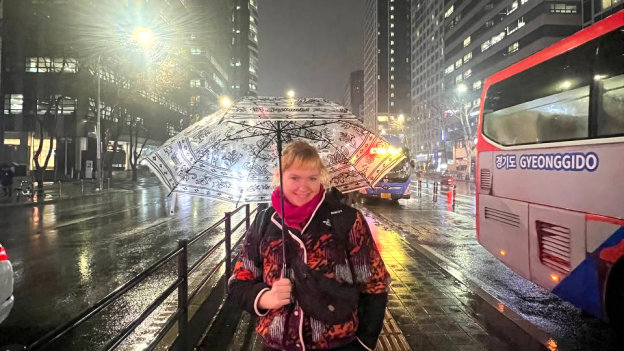
The high level of presence at the university and in the laboratory made a strong impression on me. Many students worked on their projects very earnestly and with great stamina. At the same time, the sense of community struck me as very caring and supportive. A situation that occurred in my first week was especially memorable: A student brought me an umbrella because he had read that Europeans generally do not carry an umbrella with them. First I wanted to politely decline, but he insisted that I take it. A few hours later, the rain came pouring down in sheets. This small gesture is for me emblematic of the attention to detail and eagerness to be of assistance that I repeatedly experienced in Korea.
Privat
A most welcome umbrella
I found South Korea to be an exceptionally exciting, modern and dynamic country. Many routines come off as quick, efficient and technologically advanced. Meanwhile, I found many people to be very attentive, empathic and considerate. As a German, I sometimes found daily life to be challenging from a linguistic perspective. Koreans do learn English in school, but I had the impression that they are frequently somewhat reticent to use English in everyday situations. Nevertheless, many people went to great effort to make communication possible.
One clear difference from my daily life in Germany was the extreme pressure to work hard and perform. It is expected that everyone gives their best, works long hours and is very present. For me, this pressure was at times challenging and even sometimes overwhelming. At the same time, I took away from this work culture a great deal of drive and motivation while also gaining a new appreciation of the working and living conditions we have in many areas in Germany.
The stay will have a lasting influence on my academic career. For one thing, I was able to make good progress on my research project and to integrate the results directly into my teaching and research. For another, I came away with new ideas for further collaborations. It was particularly valuable to me that the stay helped me gain a better understanding of students coming to Germany from Asian cultures. I can now more easily put myself in their place, especially with regard to language barriers, cultural codes and different academic work styles.
Privat
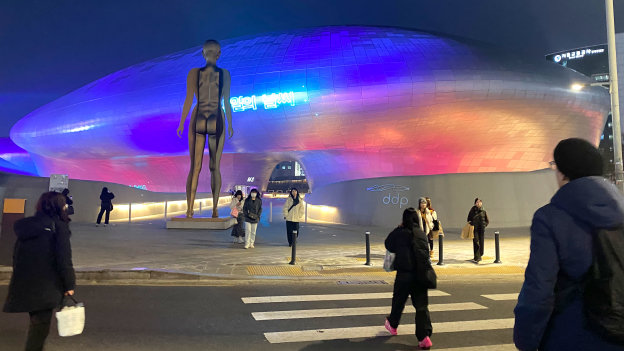
Dongdaemun Design Plaza
During my time in South Korea, I forged relationships both academic and personal that I expect will last far beyond my time there. I remain in regular contact with my cooperation partner at Ajou University and the students who worked on the project. Even outside of the university, I was able to establish contacts within the design and cultural scene. One particularly memorable exchange was with a media artist, with whom I discussed the possibility of a collaboration in the area of science communication.
From a cultural perspective, South Korea impressed me above all through the interplay of speed, drive and sincerity. The country is fast-paced and open to experimentation, with a willingness to work hard, try new things and pursue projects wholeheartedly. I also experienced great curiosity, helpfulness and a profound sense of mutual responsibility. The collaborative approach to work and the attitude of all pulling together left a particularly strong impression on me. I would like to further integrate this experience into my own research, my teaching and my artistic design work.
During my stay, I resided in a small furnished apartment in Seoul, and like most professionals there, I made a daily commute to the university. Life in Seoul is in many respects anonymous, which I initially experienced as a contrast to my everyday life in Germany. This made it all the more meaningful that I was able to quickly establish connections through my scientific and design network and felt well accepted.
Eating and drinking together makes up a central element of social life in Korea. Thanks to my acquaintances in the area of design and art, I also had the opportunity to attend numerous exhibitions and cultural events, which offered me valuable insights into the country’s art and design scene.
Privat
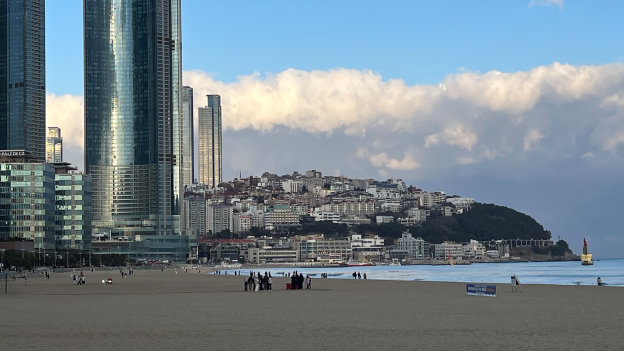
Busan beach
Seoul made a deep impression on me from an architectural and urban design perspective. I stayed in Gangnam, the city’s modern business district, which offered a particularly marked contrast with districts like Bukchon, which preserve an entirely unique atmosphere even in the heart of the metropolis. On weekends, I went on excursions throughout the country and was able to visit impressive locations like Andong, Busan and Jeju Island, which gave me a multi-layered perspective on South Korea.
I am very grateful to the DAAD-Stiftung and the KSB Stiftung for having made this research stay possible for me!
My time at Ajou University enriched my research work, expanded my academic perspectives and offered me valuable personal and cultural experiences.
I am very grateful for all of this!
As of May 2026. The German version is the original.