Gesa Witt
 Privat
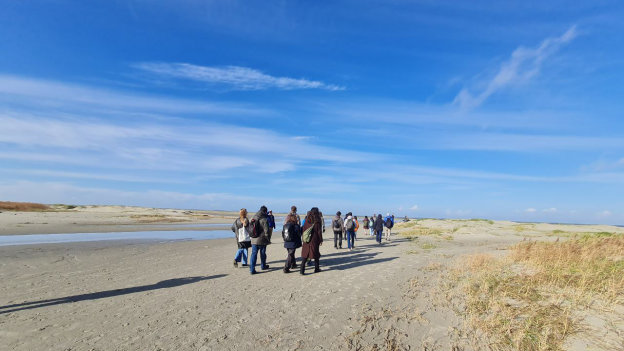
Excursion to the island of Schiermonnikoog
“The funding of my research stay in the Netherlands through the DAAD-Stiftung’s AkzoNobel Scholarship gave me a valuable opportunity to expand my professional network and gain meaningful experience in an international working environment.”
What challenges and opportunities will climate adaptation strategies have on the tourism sector? With the support of the Akzo Nobel Stiftung Scholarship by the DAAD-Stiftung, Gesa Witt conducted a comparative analysis at the Rudolf Agricola School in Groningen looking at the approaches taken on the Dutch and German Wadden Sea islands.
In the process, she also learned about the 'poldermodel' widely used in the Netherlands, a strategy that focuses on consensus rather than conflicts. Thanks to the warm welcome she received in her Dutch host family's home, her new surroundings immediately felt much more vibrant to her.
After conducting numerous interviews on the East Frisian Islands, the next step was to collect additional data in the Netherlands, gain a better understanding of the governance system there with regard to climate adaptation measures, and present initial findings.
The comparison between the East and West Frisian Islands is particularly interesting for my research, as similar challenges (such as dealing with the impacts of climate change and tourism) are addressed in different ways, and innovative approaches are being pursued in the Netherlands which may benefit the German Wadden Sea islands (e.g. concerning regenerative tourism or limits on bed capacity).
The funding of my research stay in the Netherlands through the DAAD-Stiftung’s AkzoNobel Scholarship gave me an excellent opportunity to expand my professional network and gain valuable intercultural experience. As an interdisciplinary research institute in the field of sustainable development, the Rudolf Agricola School for Sustainable Development was an excellent fit for me, particularly due to its extensive network in academia and society.
Privat
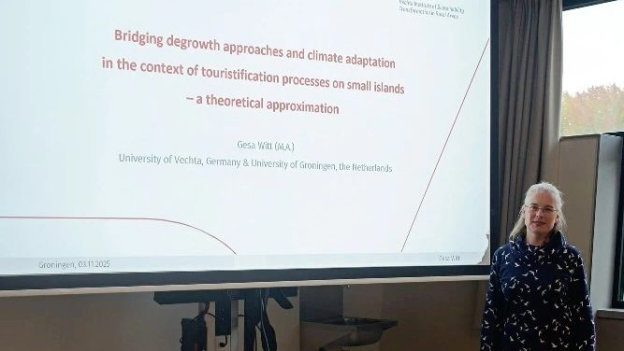
Presenting at the ISWSS
One particular highlight was presenting my initial findings at the International Scientific Wadden Sea Symposium (ISWSS), which took place in Groningen at the end of October. In this I was supported by Professor Dr Amelie Bernzen, who supervises my doctoral project in Vechta. The aim was to engage in an academically grounded exchange on how natural and anthropogenic forces influence the Wadden Sea World Heritage Site.
Participants from the natural and social sciences joined policymakers and practitioners in discussing a wide range of topics from different perspectives – from cumulative pressures and ecosystem resilience to innovative ideas for sustainability transformations. In the session on sustainable tourism development, I presented research findings on growth narratives among different stakeholders in the Lower Saxony Wadden Sea biosphere region.
Amelie Bernzen
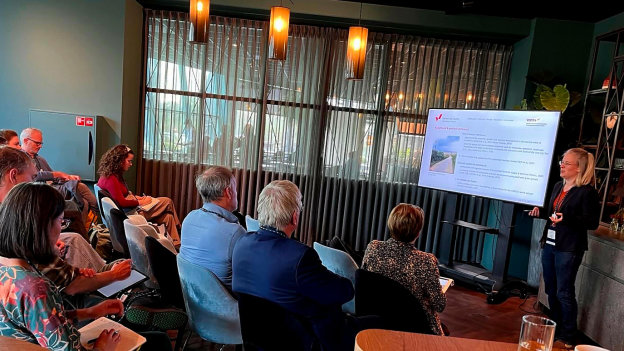
Islands Conference
This then led to a transdisciplinary exchange in January with three staff members connected to the Wadden Sea World Heritage Center (WEC) in Lauwersoog, which opened in 2025. These included people responsible for exhibition design, public relations and science communication, and the coordination of the World Heritage Site within the Waddenvereniging.
In addition to a seal hospital, the WEC also offers a range of education for sustainable development formats. The aim of the meeting was to exchange views on the significance of narratives, for example in relation to tourism growth, and look at how these can be reflected on and prepared in order to communicate transformation knowledge to different target groups. One outcome of the meeting was the insight into how important it is to establish clear definitions of terms and conduct a systematic analysis based on clearly defined criteria when it comes to evaluating narratives.
Privat
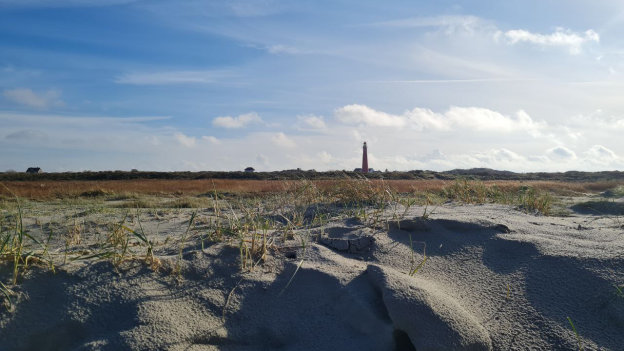
At Schiermonnikoog
As I mainly work with qualitative methods, presenting results was only one of my goals: I also wanted to obtain deeper insights into the field. After two years of collecting and evaluating data on the Lower Saxony Wadden Sea islands, it was important to me in the final year to gain greater insight into the perspectives of Dutch stakeholders.
One opportunity to do so came during an excursion to the West Frisian island of Schiermonnikoog, which took place in connection with the Islands and Sustainability Conference in early November. There I gained valuable insights into the local challenges arising in the implementation of climate adaptation measures, particularly from the point of view of the tourism sector. A good example of how such challenges can be addressed is provided by initiatives aimed at saving or reusing water, as demand is likely to increase in future due to higher visitor numbers and more hot days in summer.
Various events organised were by the Rudolf Agricola School, where I was conducting research during my stay abroad, and I was able to make use of these to expand my professional network, find interview partners, and underpin cooperation for joint research and publications. One example of this is a planned comparative study on the impact of climate impact research findings relating to questions of future housing design on the German and Dutch Wadden Sea islands. This project will continue beyond the duration of my scholarship.
I am taking many fascinating results from my stay back home for my research, including insights into the “polder model” – something that is typical of the Netherlands and is used to negotiate solutions to issues that tend to be conflict-prone. As this model originally emerged from coastal protection and land reclamation processes, it ties in very neatly with the topics of my research: consensus-based models can be a more collaborative form of cooperation than is currently practised in some cases in Germany.
By focusing on solutions or common ground rather than on problems, these generate a willingness to experiment and implement ideas, something that in Germany sometimes tends to be slowed down by complex bureaucratic processes. Over the coming months I will analyse the data collected here and combine this with the existing findings from the German islands. The initial aim of my work is to produce an academic treatment of the subject matter within the framework of my dissertation, but more practice-oriented publications could follow in the form of policy briefs, for example.
What I found personally particularly inspiring about the way of working and living that I experienced here was the high level of trust placed in me from the outset, and also the pragmatism that is embraced in practice, often leading to a greater focus on solutions rather than on insisting on problems.
There weren’t any major differences from my working environment in Germany, which is also very supportive, but the broader social climate and the way people interact are different (one concrete example here are the border controls on the German side, which travellers and commuters are currently having to deal with).
I was given a very warm welcome in my new environment and was made to feel at home by so many people. Many of them immediately put me in touch with contacts who were able to help me in my research. I would like to say a big thank-you at this point to all colleagues at the University of Groningen as well as to the practitioners and interview partners for your time!
This includes in particular Professor Dr Frans Sijtsma and his team of staff and doctoral researchers at the Rudolf Agricola School, and also Professor Dr Dimitris Balas and other lecturers, students and doctoral researchers at the ISLANDS and Sustainability Research Master’s at the Faculty of Spatial Sciences.
Privat
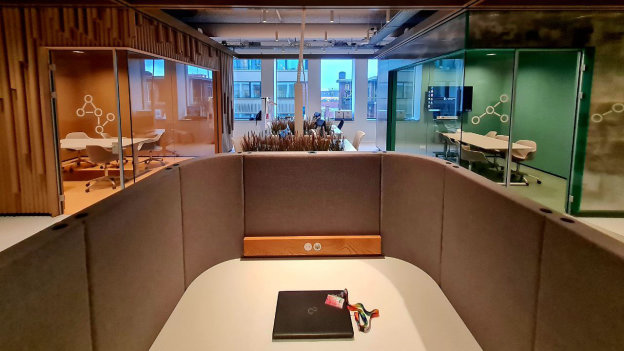
Co-Working space
Since I was based in the co-working space at the House of Connections right in the city centre, I was able to take part in events, exchange initiatives and networking events on a regular basis, which meant that I quickly felt very much at home there, both personally and academically. I also had the opportunity, for the first time, to attend a dissertation defence ceremony, which was a particular academic highlight for me, as defences in the Netherlands are far more formalised and tradition-bound than in Germany.
I am certain that my research stay at the Rudolf Agricola School will have a very positive influence on my future academic career. Even now, collaborative ventures have emerged that will bear fruit beyond the period of the scholarship, and I am confident that these will continue and develop further.
Eva Rahe
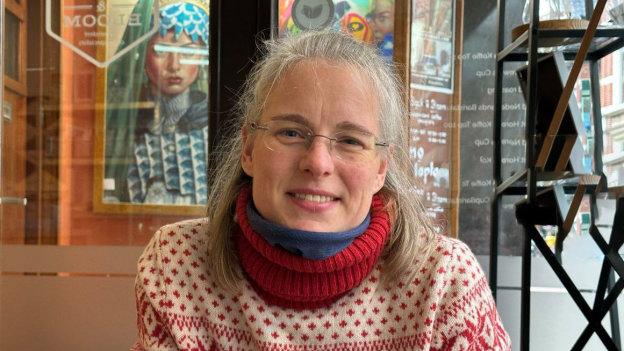
At a favourite cafe
On a personal level, what will stay with me most is my home with my Dutch host family. Because of them, the new city immediately felt lively and much less anonymous than it would have done had I been living in student halls, for example. Thank you for welcoming me so warmly!
What also helped create a sense of community for me was the regular exchange with other international students and doctoral researchers in my language classes, as well as taking part in various social and cultural events, for example at Forum Groningen, the Grand Theatre, and at the university in connection with the studium generale. My favourite places for creative breaks were Black & Bloom and Books & Coffee – both very close to the library and the office.
Privat
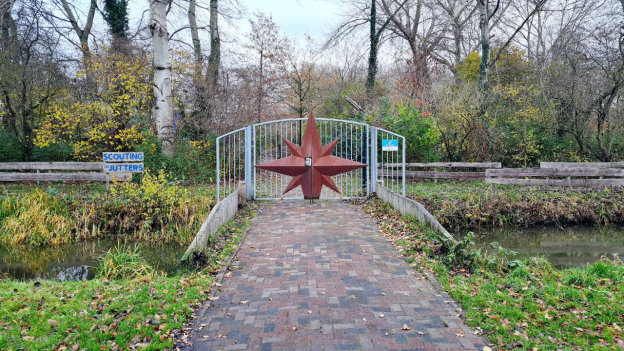
Path to scout island
I also have vivid memories of the weekly group sessions with the scout children (aged five to seven) in my neighbourhood: for me, voluntary involvement in a club – or, as they say here, a vereniging – is often the best way to settle into a new culture and language. It is probably a coincidence – or perhaps it isn’t? – that the group’s site is located on a small island (surrounded, naturally enough, by drainage ditches).
Perhaps unsurprisingly for someone researching islands, this is a place where you one can forget time, space and everyday life for a while and recharge for the next research adventure.
As of January 2026. The German version is the original.