Laura Lüthy
 Privat
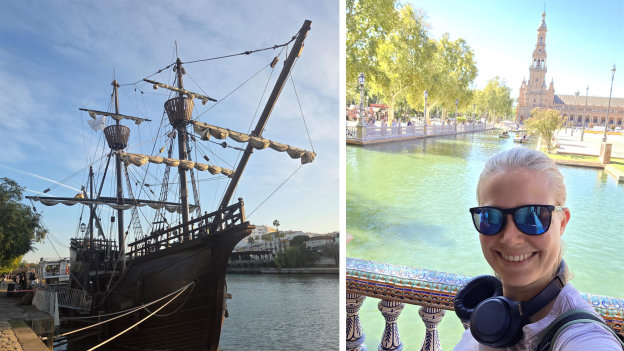
Replication of the vessel Nao Victoria and Seville
“Thanks to the Professor Bingel Scholarship offered by the DAAD-Stiftung, I was able to significantly advance the methodological aspects of my dissertation and establish valuable international collaborations that will support my academic work in the long term. The stay opened up new perspectives and had a lasting impact on both my academic and personal development.”
With the support of the Prof. Bingel Scholarship by the DAAD-Stiftung, Laura Lüthy, a doctoral candidate at the University of Konstanz, spent several months working at Doñana Biological Station in Seville, an internationally recognised centre for ecological research. There, she used the results of her previous field research to develop a dynamic population model for predicting how animal populations would develop in different climate scenarios. She quickly settled into everyday life in Spain and also learned to appreciate the late mealtimes typical of Southern Europe.
My doctoral research involves investigation of the impact of climate change on an endangered primate species, namely the red colobus monkey (Piliocolobus tephrosceles), in Uganda. The focus is on how climatic change affects behaviour, diet and population dynamics, both directly (e.g. through temperature and precipitation) and indirectly (as a result of changes in food availability).
In the first two chapters of my dissertation, I examine how plant phenology in Kibale National Park in Uganda is influenced by climate on both a seasonal and long-term basis, and how climate and food availability affect the behaviour and diet of red colobus monkeys. The aim of the third chapter is to link these findings to approaches from the field of population ecology.
Specifically, I model how our study population has developed over the past ten years or more, which factors have had the greatest influence, and how it is likely to develop under different future climate scenarios, including an assessment of extinction risk.
Privat
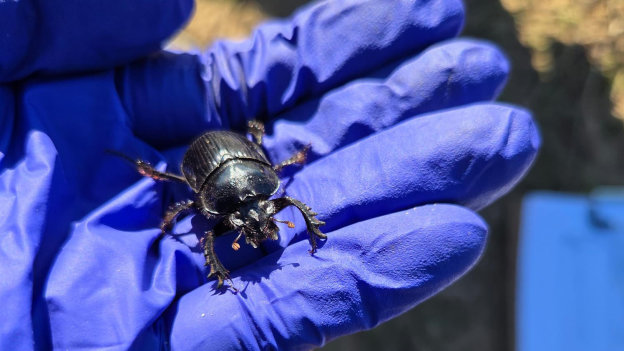
Measuring dung beetles at Doñana Biological Station
Thanks to the Professor Bingel Scholarship, I was able to spend two months at Doñana Biological Station (EBD-CSIC) in Seville, an internationally recognised centre for ecological research. I am conducting my doctoral research at the Max Planck Institute of Animal Behavior and the University of Konstanz. The research stay in Seville gave me the great opportunity to work with a group leader who is an expert in population ecology. I already knew her from my time as a bachelor’s student at the University of Zurich, where she was working as a postdoctoral researcher. She is now a group leader in Seville. This connection was extremely helpful for the successful implementation of my third chapter.
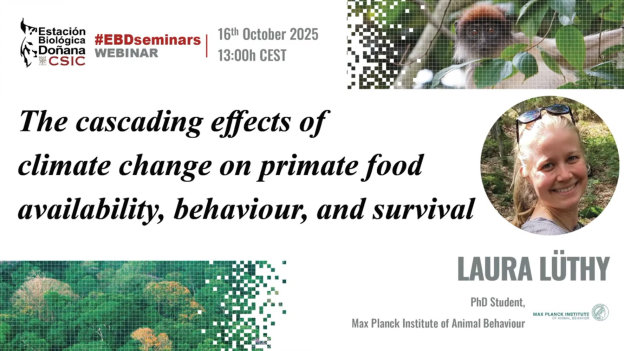
After my arrival, I also had the opportunity to present the first two chapters of my dissertation at the institute’s scientific seminar. The subject-specific dialogue with researchers in Seville was in-spiring and broadened my perspective on scientific questions. I met many wonderful people from different areas of ecology, shared lunches with them and discussed a wide range of topics.
Privat
Presentation at the institute
We also went on excursions and spent time together after work, for example kayaking on the Guadalquivir and visiting the city’s many ice cream shops. At the same time, I benefited greatly from the experience of other group members and postdocs. It was particularly valuable to meet a re-searcher at a seminar who had worked on the same project several years earlier and had extensive subject-specific expertise.
During my time in Seville, I worked closely with my supervisor, who is a senior expert in dynamic population modelling. Through intensive discussions with my host, I was quickly able to develop an initial dynamic population model and also define a clear plan for further methodological development, forming the basis for a joint publication. I also gained insight into a new research direction involving the use of theoretical and statistical models to generate projections and “digital twins,” and I established valuable contacts for my future career.
Privat
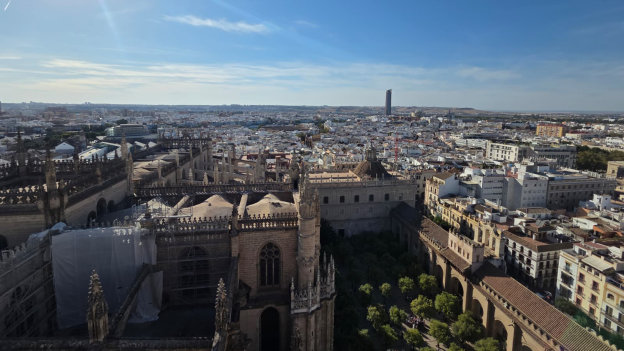
Seville Old Town
Alongside my academic work, I thoroughly enjoyed life in Seville. The historic city is vibrant, architecturally impressive, and easy to explore on foot or by bicycle. I lived in the Triana district and used the Sevici public bike-sharing system every day to travel to the institute, enjoying twenty minutes of sunshine each day and cycling past the impressive facilities of Isla de la Cartuja, the site of the 1992 World Expo.
It took some time to adjust to Spanish meal times – lunch in the late afternoon and dinner often not until after 9 pm – but I quickly came to appreciate this way of life. The many hours of sunshine and mild autumn temperatures were particularly pleasant and were in stark contrast to the grey day-to-day routine in Germany. Seville also offered a rich cultural life: flamenco performances, kayaking on the Guadalquivir, and the major event marking the switching on of the Christmas lights all stand out in my memory. As a keen sailor, I was also particularly fascinated by the replica ship and museum dedicated to the first circumnavigation of the globe which set out from Seville in 1519.
Privat
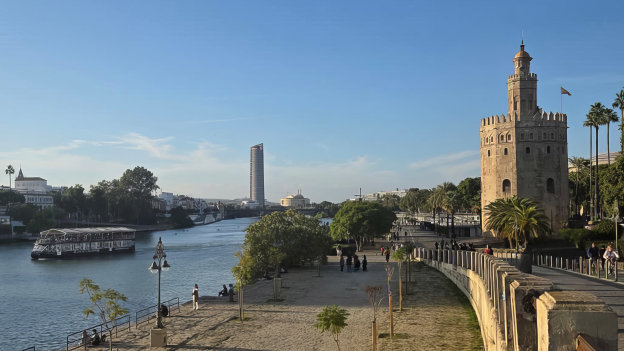
Torre del Oro at the old harbour
The stay was also a linguistic challenge and enrichment. At the beginning, I spoke hardly any Spanish, and even simple everyday interactions – such as checking in daily at the institute’s security desk – were initially difficult and often required gestures and facial expressions. But over the course of the two months I made significant progress and was eventually able to hold short conversations without automatically switching to English. This not only made everyday life easier but also facilitated integration in the institute, as some of the presentations and informal discussions were in Spanish.
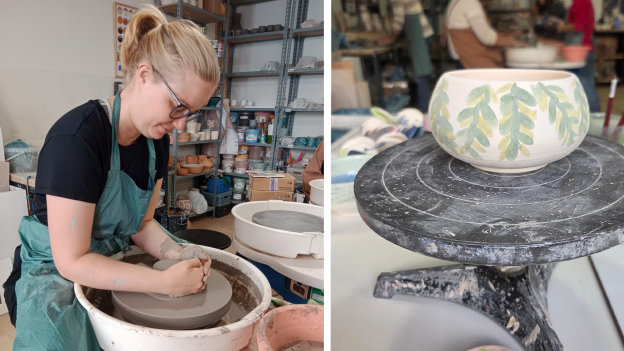
In addition, I took part in a pottery course located on my street in Triana, a district that is known for its ceramics. Despite my limited Spanish, I greatly enjoyed the experience with the Sevillanos, who were extremely friendly and welcoming and, with big smiles, taught me a great deal about pottery.
Privat
At the pottery lesson
Another highlight of my stay was the opportunity to take part in fieldwork in Doñana National Park. There, I supported the research team in studying dung beetles, which were attracted using cow dung, identified and then measured in order to gain a better understanding of their life cycle and climatic influences. The sandy Mediterranean ecosystem contrasted significantly with the tropical forests I was used to from my own field research. The landscape, biodiversity and encounters with other international research groups left a lasting impression.
In retrospect, the research stay in Seville was extremely enriching both scientifically and personally. I will particularly remember the openness and friendliness of the people, the inspiring conversations, and the opportunity to focus intensively on advancing my dissertation over a defined period of time. I was able to establish valuable academic contacts that will endure beyond the stay and enable future collaborations.
After my return, I will continue refining the developed models, incorporate the results into my dis-sertation, and prepare the joint publication. The stay at Doñana Biological Station had a lasting impact on my academic work and provided new methodological perspectives and scientific impulses for my future career.
I am very grateful to the DAAD-Stiftung for the funding I received through the Professor Bingel Scholarship, which made this research stay possible. I would also like to thank my host and the colleagues at Doñana Biological Station for their professional support, openness and the excellent collaboration. My time in Seville was of great value in terms of both my academic and personal development, particularly through the in-depth discussions, methodological advancement, and the new connections that will accompany my work in the long term.
As of November 2025. The German version is the original.