Annabell Hüsken
 Privat
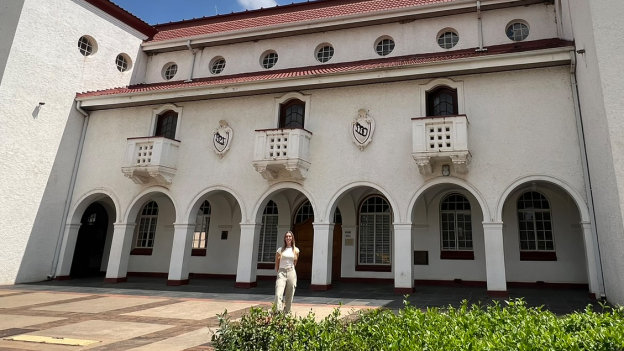
In front of the North-West University in Potchefstroom
"The Helmut & Babs Amos Scholarship from the DAAD-Stiftung provided a transfor-mative opportunity for me to conduct research in South Africa. The stay was a pivotal experience that allowed me to gain fresh professional insights and meaningful intercultural connections."
Annabell Hüsken’s doctoral research focuses on studying freshwater snails and their parasites, which are flatworms known as trematodes, in freshwater environments. Due to their close interaction with various hosts, trematodes are valuable indicators of the ecological health of waterways. North-West University in Potchefstroom, with its focus on parasitology research, was the ideal host institution for Hüsken’s stay, which she was able to undertake with the help of the Helmut & Babs Amos Scholarship by the DAAD-Stiftung. An enthusiastic amateur photographer, she used her camera to capture her diverse impressions beyond the purely scientific field, such as the fauna of the Highveld.
The time I spent researching in South Africa was an exciting and enriching experience for me. Collaborating with North-West University and presenting at an international conference allowed me to strengthen my doctoral thesis and gain essential international research experience.
Beyond my research, I experienced South Africa as an incredibly vibrant and multifaceted country, one to which I firmly intend to return in the future. I wish to extend my sincerest gratitude to the DAAD-Stiftung, my sponsor Helmut Amos of the Helmut & Babs Amos Scholarship, and Prof. Dr. Nico Smit of the Water Research Group at North-West University for the invaluable support and guidance they provided during this transformative experience.
Privat
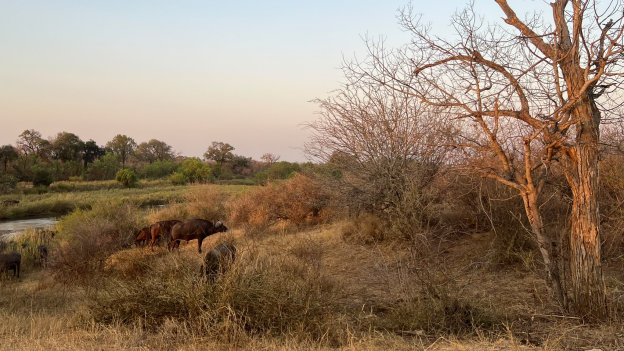
Kruger National Park
After arriving in Potchefstroom, I barely had time to unpack my large suitcase and repack a smaller one before I was on the move again: The following morning, I set off immediately with my colleagues from the Water Research Group at North-West University (NWU) for Skukuza Camp in Kruger National Park, where we participated in the 5th International Congress on Parasites of Wildlife.
Commencing my research stay with an international conference provided a seamless integration into the new working group. After delivering my own presentation on the opening day, I spent the following four days engaging with the diverse conference programme. This provided a valuable opportunity to meet international experts in person, such as Prof. Dr. Thomas Cribb from Australia and Dr. Jenny Dunn from England, whose work I had previously only encountered in the literature.
Privat
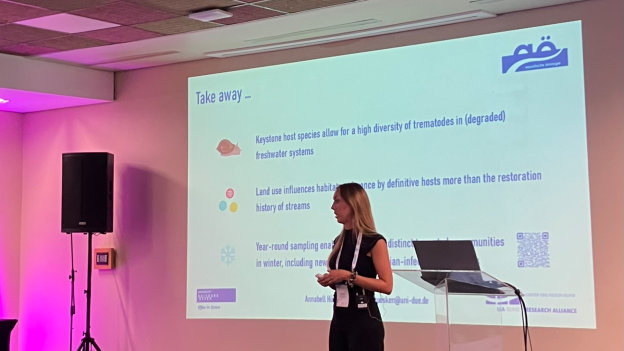
Presentation at the 5th ICPOW in Kruger National Park
The days began with sunrise game drives in the park, followed by a rigorous academic programme. This offered a comprehensive overview of my colleagues' expertise, including work on marine fish ectoparasites and the identification of newly discovered blood parasites. The conference programme encompassed a broad spectrum of topics within parasitology, ranging from veterinary and public health risks to the evolution and biodiversity of parasites. It also highlighted their crucial ecological roles within both terrestrial and aquatic ecosystems. On the final day of the conference, my host, Prof. Dr. Nico Smit, delivered a keynote address on the conservation of parasites. He highlighted the critical issue of co-extinction, where parasites face the threat of disappearing alongside their endangered hosts.
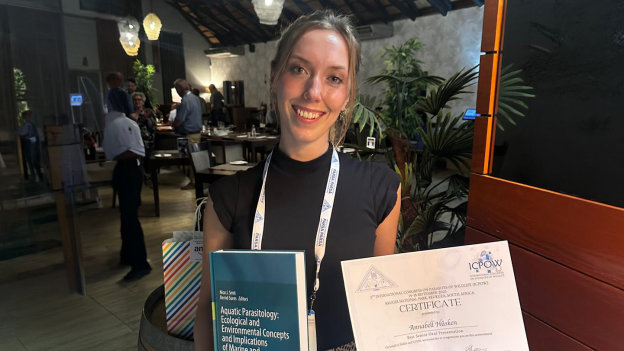
By the end of the conference, I had not only gained valuable insights into the field but also received positive feedback from the scientific audience for my own presentation, titled 'Beyond Restoration: Environmental Drivers of Trematode Dynamics in Recovering Streams', and I was awarded the prize for best lecture in the group of undergraduates and PhD students.
Privat
Award for “Best Senior Oral Presentation“
The Water Research Group's strong focus on parasitology positioned it as the ideal host institution for my research stay at NWU. Building on an existing cooperation with the University of Duisburg-Essen, where I am pursuing my doctorate, I had already established contacts within the group. This prior engagement allowed me to familiarise myself with their methodologies and expertise, ensuring I could optimise the preparation for my stay.
Following my return to Potchefstroom, the core research phase of my stay began: a systematic study of freshwater snails and their trematode parasites within South African aquatic ecosystems. Trematodes (commonly known as flukes) possess complex life cycles typically involving three successive hosts: a vertebrate as the definitive host, a freshwater snail as the first intermediate host, and a second intermediate host. Depending on the trematode species, the latter may encompass a wide range of organisms that form part of the definitive host's diet.
While the adult stages of many trematodes are comprehensively documented, the larval stages within their intermediate hosts remain poorly understood, and their complete life cycles are rarely fully elucidated. Due to their complex life cycles and obligate associations with diverse wildlife hosts, trematodes serve as sensitive bioindicators of the ecological integrity of aquatic ecosystems. The primary objective of my stay was to characterise trematode diversity in South Africa, elucidate their complex life cycles, and derive ecological insights regarding the status of the sampled ecosystems.
Privat
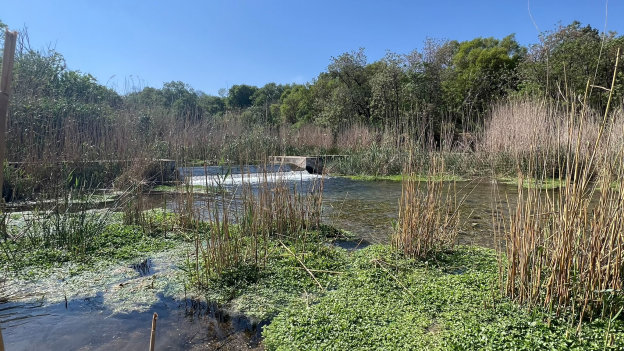
Sampling
During my very first week at NWU, we commenced the field collection of freshwater snails across various aquatic habitats. Fieldwork required significant adaptability to the unpredictable South African spring, with temperatures shifting from 32°C and sunny to 18°C and raining in a single day. Despite these challenges, the week resulted in a productive yield of over 500 collected snails. Subsequent weeks were dedicated to identifying infected specimens, followed by a rigorous process of morphological characterisation via microscopy and molecular genetic analysis.
Conducting research in a new laboratory provided valuable insights into the institutional workflows and standard operating procedures of the host university. Consistent with my broader experience in South Africa, I found the professional environment to be exceptionally collaborative, supportive, and collegial. In contrast to the more informal atmosphere of my research group at the University of Duisburg-Essen, I observed a more pronounced academic hierarchy at the host institution and it is standard practice to address colleagues by their respective titles. Master's students are also deeply integrated into the research group; they maintain a consistent daily presence on-site to advance their projects and contribute to publications.
Comprising five professors and eight postdoctoral researchers across parasitology, ecology, and ecotoxicology, the Water Research Group consists of over 30 members. This multidisciplinary environment allowed me to broaden my academic perspective and acquire specialised methodologies through intensive collaborative exchange.
Privat
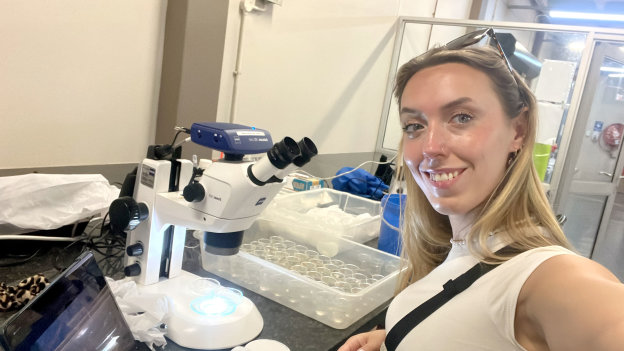
At the lab, studying aquatic snails
I was particularly focused on the taxonomic proficiency of my colleagues and the acquisition of methodologies for species description. This included mastering fixation and staining protocols essential for the collection of standardised morphometric data. At the same time, I was able to contribute fresh perspectives and new methodological insights to the research group. As the Water Research Group's primary focus is on fish parasitology, several colleagues consulted with me specifically to examine the identified cercariae (intramolluscan larval stages) and to discuss elucidating their potential life cycles.
Moving forward, I will synthesise the findings from my research stay in continued collaboration with my colleagues at NWU. The data collected provide compelling avenues for future research and serve as a robust foundation for long-term scientific collaboration between our institutions.
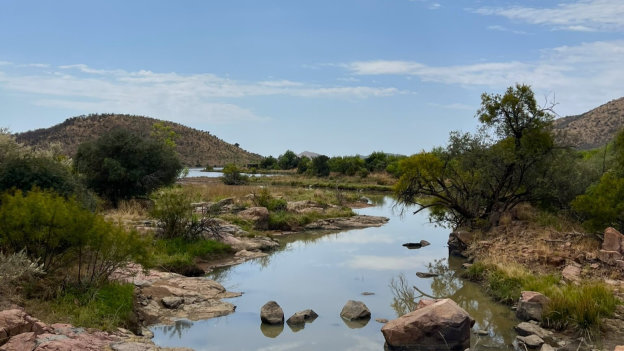
Beyond my research, Potchefstroom offered numerous opportunities to explore the local region and its unique cultural landscape. My colleagues were incredibly hospitable, ensuring that my weekends were filled with engaging social activities and opportunities to explore. Weekend activities provided a wonderful balance to my research, ranging from wildlife excursions in Pilanesberg and riverside walks in Potchefstroom to hiking the Vredefort Dome, a globally significant asteroid impact site.
Privat
Trip to Pilanesberg
As an avid nature and wildlife photographer, I made sure to document my research stay; this allowed me to create a lasting visual record of the unique landscapes and species I encountered in South Africa. Situated at an altitude of 1,340 metres, Potchefstroom lies within the Highveld, a high-altitude plateau dominated by grassland biomes and home to a diverse array of flora and fauna specifically adapted to the unique environmental conditions of this ecoregion.
Beyond the remarkable wildlife in the national parks, I also captured several unique species in and around Potchefstroom. These included a Puff Adder, one of South Africa's most highly venomous snakes, and the Long-tailed Widowbird, whose males develop a striking 50-cm tail as part of their spectacular breeding plumage.
I was also struck by the routine interactions with South African wildlife. Even on the NWU campus, one had to stay alert to the distinctive, raucous vocalisations of the Hadada Ibis and the playful antics of the vervet monkeys. I also enjoyed a vibrant cultural programme, including the Snowflake Market, known for its regional cuisine and handmade crafts, and the Aardklop National Arts Festival, which transformed Potchefstroom into a hub of Afrikaans theatre, music, and cabaret, as well as Heritage Day, a major national holiday where South Africans celebrate their diverse cultural identity and the rich heritage of the 'Rainbow Nation'.
I found myself pleasantly surprised by the local culinary landscape. While it is common for a single meal to feature two or three different types of meat, South African cuisine also offers a surprising variety of creative vegan and vegetarian options. Even at a traditional braai, I always found excellent options to cook over the open fire, allowing me to fully participate in this social custom. I will also particularly miss the local fresh fruits and the snacks made from pecans.
The open and warm nature of the people in South Africa made me feel welcome right from the start. I look forward to reconnecting with several colleagues from Potchefstroom next year at the Ichthyoparasitological Symposium (IPS) in Germany.
Overall, I look back on a time of tremendous growth, during which I gained a wealth of professional knowledge and unforgettable personal memories. I am delighted that this stay marks the beginning of a new collaboration rather than the end of a project, providing a strong basis for our future joint research. I am currently co-authoring the first publication based on our collected data with my new colleagues. I look forward to future opportunities to return to the research site and continue our on-site collaboration.
As of November 2025. The German version is the original.