Retang Mokua
 Privat
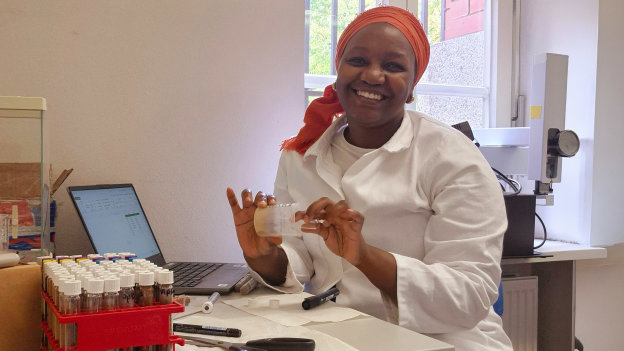
Samples at the soil laboratory
“I am sincerely grateful for this research opportunity which provided valuable scientific experience, enhanced my analytical skills and equipped me with the competence to independently carry laboratory work to advance my research. Personally, this visit broadened my international network and enriched my cultural perspective, enhancing both my confidence and professional growth as an individual.”
As part of her postdoctoral project, Dr. Retang Mokua had the opportunity to spend three months in Germany, funded by the KSB Stiftung Scholarship of the DAAD-Stiftung. Her research formed part of a collaboration between the South African Environmental Observation Network and the Bundesanstalt für Geowissenschaften und Rohstoffe (BGR) in Berlin, focusing on understanding the link between vegetation change in forested mountain catchments and water resources. As Retangs stay in Berlin coincided with her birthday, her colleagues surprised her with a traditional German birthday cake.
This report summarizes my research visit to the Federal Institute for Geosciences and Natural Resources (BGR) in Germany, made possible through the support of the KSB-Stiftung Scholarship by the DAAD-Stiftung.
As a postdoctoral fellow at the South African Environmental observation Network (SAEON) based in Limpopo Province, South Africa, I was excited and looking forward to my scientific research experience in Germany. My travel preparation was very smooth, including my visa application, finding accommodation and arrival in Berlin, Germany.
My research visit commenced on July 1 at the Spandau Isotope Laboratory in Berlin, where I collaborated closely with Dr Paul Koeniger and Mr Sebastian Friebe at the BGR. I chose to conduct my analyses at BGR because the facility provides advanced laboratory equipment required for plant water extraction and high precision stable isotope analysis, resources that remain limited in my home country.
A key motivation for the visit was driven by the analytical challenges associated with cryogenically extracted xylem when analyzed using Isotope-Infrared Spectroscopy (IRIS). Such samples are prone to organic contaminants (e.g., methanol and ethanol), which can cause spectral interferences and introduce uncertainties in isotope measure-ments. These uncertainties complicate the accurate identification of plant water sources and the depth from which plants extract their water.
Privat
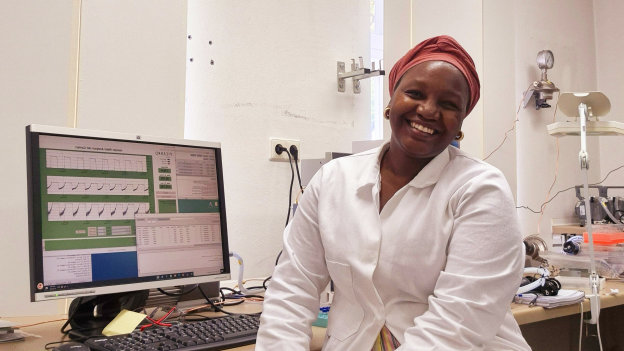
At the BGR Lab
The primary aim for this visit was to apply cryogenic vacuum extraction to obtain water from plant xylem and soil pore water, and to receive hands-on training in stable isotope analysis using Picarro isotope analyzers. A concrete goal of the visit was to ensure the complete extraction and analysis of my water samples and to gain technical competence and confidence to independently operate the extraction system and perform isotope analyses, which I had successfully achieved during this period.
This training directly supports my research investigating the effects of vegetation changes on river flows. The high-quality stable isotope data will allow for reliable quantification of plant water sources and strengthen interpretation of vegetation-driven changes in catchment hydrology and improve water resources management.
Official research activities started on July 14, following a safety induction and facility orientation. I was provided with an office, laptop, and safety equipment. Despite challenges such as delayed gas deliveries and occasional sample contamination, the experience was highly rewarding. The results indicated large groundwater usage by invasive and riparian trees which poses a large risk on river flows which are high dependent of groundwater discharge in this area.
Privat
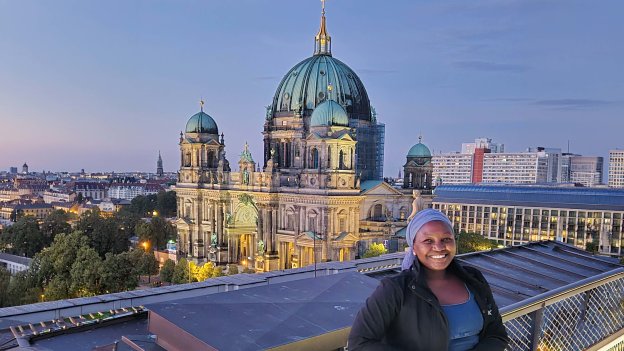
View at Berlin Cathedral
The skills gained will contribute to a planned publication in the Hydrological Sciences Journal (submitted and under review). A special issue contributions of isotope hydrology to water sciences in Africa: Revisiting foundations and exploring new research trends. Furthermore, this experience was accompanied by a newsletter published under my research institute, SAEON. The results of this research will help with restoration initiatives of native vegetation in the Klaserie river catchment.
My collaboration with BGR, which began during my Master’s studies at TU Darmstadt in 2015, has now evolved. We have now extended an invitation to Dr Koeniger to visit our laboratory and site in South Africa to assist with setup. With experience, we are planning future joint projects using stable isotope-based techniques, which will involve PhD and Master students.
The work culture at BGR stood out for its flexibility, teamwork, and focus on work–life balance. Germans priorities sharing responsibilities and we had occasional progress meetings (“check-ins”), where one was free to discuss challenges and they always offered a helping hand. This is something that we often lack in our working environment back at home. My biggest challenge was software such as R and I was able to receive assistance from a colleague. Importantly my colleague would also help with translations where needed.
Privat
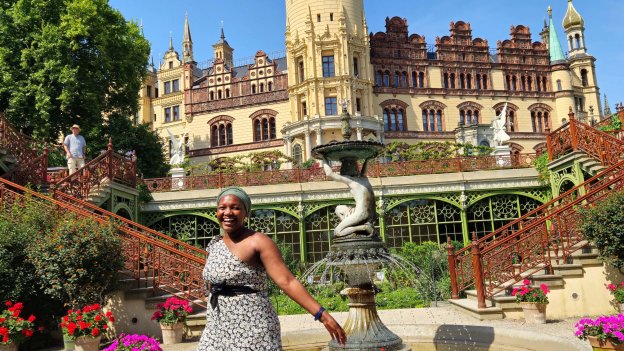
In Schwerin
The respect for time, especially with public transport, amazed me, something that I am not accustomed to in South Africa. Furthermore, Germans do not work on weekends and Sundays are dedicate to family considered quiet and rest day. Examples being the closing of shops, whereas in South Africa Saturdays and Sundays can be full working allowing one limited time with family or to do extra-mural activities for relaxation.
I was fortunate to have secure accommodation quickly through HousingAnywhere, which was very efficient and reliable. I stayed at Home In Berlin (Lichtenberg), where I felt safe and welcomed. My neighbors kindly greeted me with gift cards, and there was as strong sense of community supported by a tenant’s group chat where we shared recommendations of places to visit, public transport, and language courses.
I encountered friendly people from India, West Africa, southern Germany, and South America. Having previously lived in a smaller German town, Berlin initially overwhelmed me. However, I gradually adjusted exploring different routes from Lichtenberg to Spandau daily. Kurfürstendamm became a favorite, I was charmed by blending of skyscrapers and old Kaiser Wilhelm Memorial church. I was pleasantly surprised that food prices remain relatively affordable compared to South Africa. The convenience and variety of grocery stores such as Rewe and Aldi felt similar to South Africa. Overall, living in Berlin was both culturally enriching and personally rewarding.
Privat
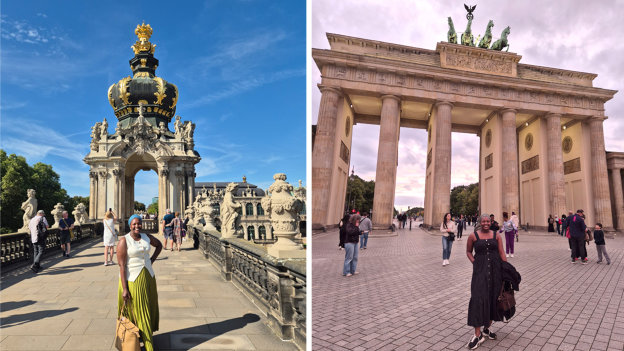
In Dresden and at the Brandenburger Tor
I celebrated my birthday with colleagues who kindly brought variety of fruit cakes. During my stay, I visited sites as Humboldt Forum and the Berlin Mauer East Side Gallery and enjoyed team dinner, where I had a taste of German pastries (e.g., Berliner jam doughnut) and cuisine with my favorite being the Kartoffelsalat and Kartoffelklöβe, which differs from our South African versions. I was also invited to dinner by a colleague who served Germknödel, a traditional Austrian dessert.
Using my Deutschland ticket, I travelled to Dresden and Schwerin, both rich in culture, history and beautiful architecture, with scenic train journeys along the way. Having previously studied in Darmstadt, as I was already familiar with the German culture, transport system, shopping and the German language itself. I had a great experience in a big city such as Berlin, discovering new sites guided by my colleagues and my favorites being the Berlin Dom and Brandenburger Tor.
We are also planning future collaborative projects with BGR, including student involvement at MSc and PhD level, and a reciprocal visit to support laboratory setup in South Africa. This research stay has therefore influenced my academic path by reinforcing my focus on isotope-based ecohydrology and international collaboration. This visit not only enhanced my technical expertise but also inspired me to apply similar collaborative and cultural values in my professional environment at home.
As of October 2025.