Annie Mascot
 Privat
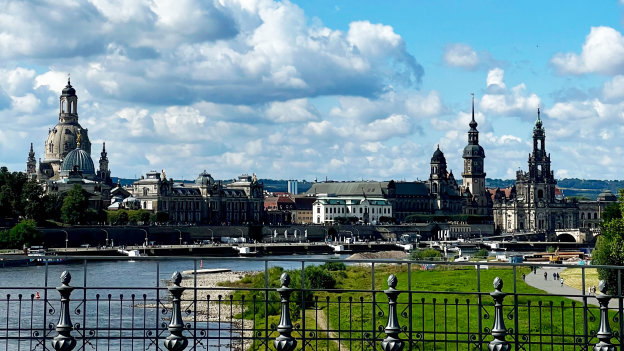
Dresden panorama
”In the summer of 2025, I was fortunate to live and work in Germany as a researcher at TU Dresden through the DAAD-Stiftung (Helmut and Babs Amos Scholarship). My stay in Germany significantly advanced my growth as a researcher through hands-on experience conducting animal trials to further my PhD work while also fostering personal development by immersing me in a new culture and building a sense of home abroad.”
The Helmut & Babs Amos Scholarship by the DAAD-Stiftung allowed Annie Mascot to collaborate with scientists from the Technical University Dresden to advance minimally-invasive robot-assisted surgery. During her stay, she gained first-hand experiences of the differences in academic life in Germany and the USA. Outside of the lab, she explored the city, visiting weekend markets and cafes.
It is the goal of my PhD to advance our understanding of women’s healthcare through an engineering approach, specifically gynecological care and how we determine the health of the cervix. During my stay, I investigated the capabilities of novel sensor with potential clinical applications I led the design of at my home university (Stanford University).
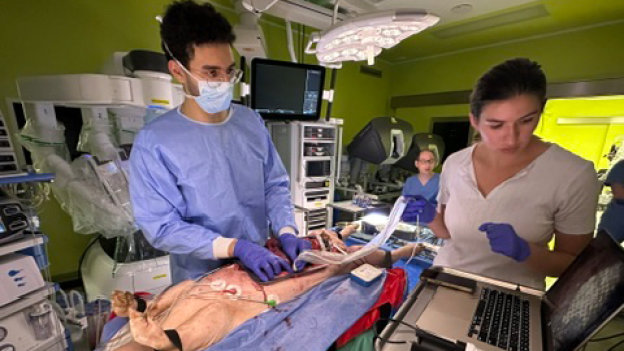
My research focused on completing and analyzing three terminal porcine studies, in which various organs were tactically captured and classified based on their subtle textural differences using a machine learning model. Thousands of tactile images were collected across three organ types, and we were able to train a preliminary model that classified these images by tissue type with very high accuracy.
Privat
Capturing tactile images using the sensor
Before coming to TU Dresden, my PhD work at Stanford University had mainly involved needs finding and device design/fabrication for high-need problems in medicine. This is the area of research I am most familiar with, coming from a mechanical background. However, my PhD work needed to be supplemented with techniques in machine learning and AI model training and implementation, which is why my summer position at TU Dresden was so impactful.
Privat
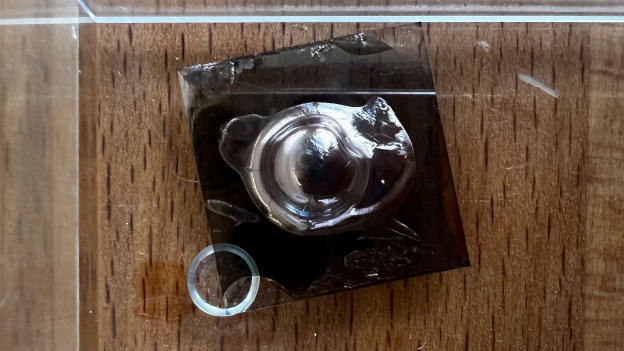
Gold coated sensor tip
I knew nothing more than the very basics coming to work in the department of computer science at TU Dresden, and I left with more knowledge of AI and confidence in my ability to do more in the future. I specifically chose TU Dresden to help push me out of my comfort zone and aid in developing these key skills, and I am happy to say all my colleagues and advisors helped me to get there with kindness.
Privat
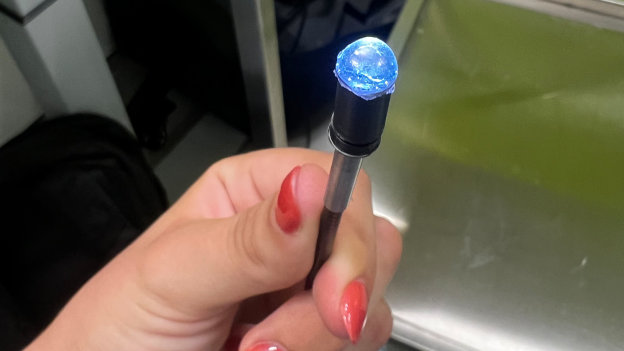
Sensor in action
I was also able to conduct 3 animal trials using my device, which was a new and very valuable experience. I learned the inner workings of an OR and the logistics of running an animal study, which are important lessons I will continue to take with me at Stanford University.
While further work is needed to validate the robustness of this approach, my time in Germany was invaluable for collecting the preliminary data that will propel my research forward. I hope to build on these results to demonstrate a promising proof of concept for this novel sensor hardware, with the goal of applying the technology to women’s healthcare over the remainder of my PhD.
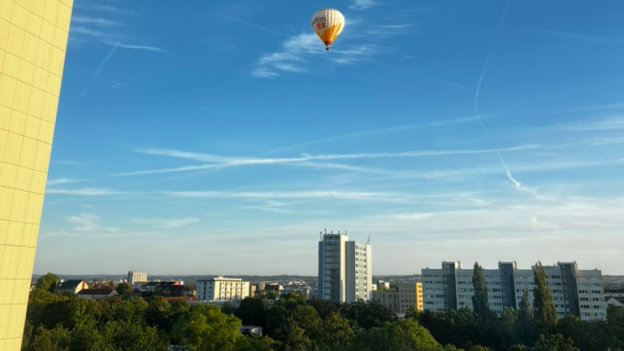
Privat
View on Dresden from Wohnheim
One of the most meaningful lessons I took away was how cultural differences shape both academic and daily life. As many who have studied in America might note, there is an emphasis on being as efficient as possible, with urgency often being associated with productivity. While there are advantages to this approach, I noticed that German work places often move at a thoughtful, steady pace. I could take the time to reflect on each experiment, which made my work feel more intentional and rewarding. I am now able to take the advantages of both perspectives and apply them to my work in the future.
Personally, I was also struck by the daily rhythm in Dresden - Sundays were truly reserved for rest, with shops closed and the city quiet, which encouraged me to embrace balance and appreciate downtime in a way that felt less common back home. Experiencing both the professional and personal sides of these cultural differences was invaluable for my growth.
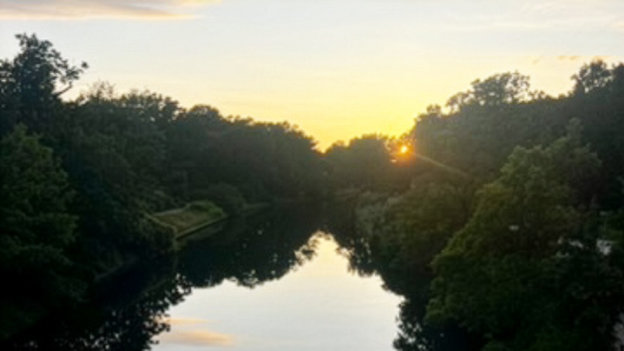
Privat
Berlin Tiergarten
Beyond the lab, I had the chance to explore Germany culturally and personally. A visit to Berlin was a highlight, but what I valued most was immersing myself in daily life in Dresden. Over time, the city came to feel like home rather than a temporary stay. I made good friends with my colleagues in the lab and other university students I met playing pick-up beach volleyball.
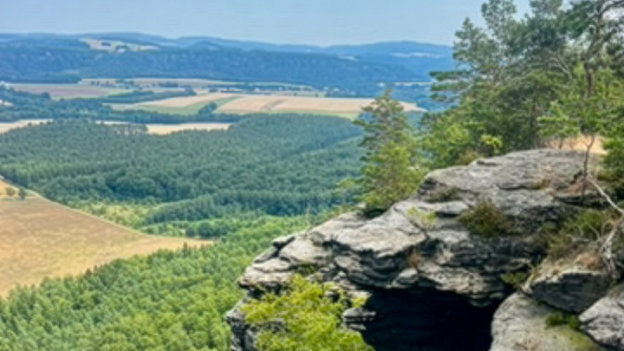
Privat
Saxon Switzerland
Making friends with local students made a huge difference in how I connected with my environment and made it much more like home. I grew accustomed to the local pace of life and community by shopping at the weekend markets, spending Sundays in cafés and parks (particularly the beautiful Großer Garten and Elbe River), and appreciating the quieter rhythms of the city. These simple, wholehearted moments are what I will treasure most.
I would like to conclude by expressing my deepest gratitude to my generous donors, Helmut and Babs Amos, for giving me the invaluable opportunity to broaden my academic experience during my PhD while living in Germany. I had an amazing summer, and this experience will always hold a special place for me. I am now back at Stanford University, where I will carry forward the lessons I learned in Dresden as I continue advancing engineering for women’s health. Thank you.
As of September 2025.