Paul Feller Gumucio
 Privat
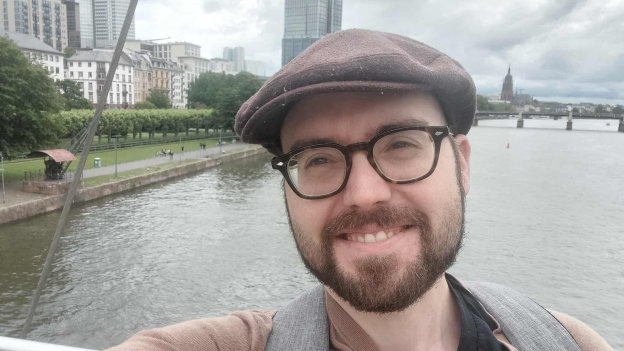
At the Main River in Frankfurt
“I am grateful to have been awarded the Respekt & Wertschätzung Scholarship by the DAAD-Stiftung, with the generous support of Dr. Michael Aven. This two-month research stay in Germany, hosted primarily at the Herzog August Bibliothek in Wolfen-büttel and at Friedrich-Schiller-Universität Jena, provided invaluable academic, inter-cultural, and personal experiences.“
Paul Feller Gumucio was born in Chile and first completed his undergraduate studies in musicology there. The idea of conducting research in Germany emerged during his Master's studies at Northwestern University in Evanston, USA, where he developed a keen interest in the Middle Ages and Jewish studies.
During his time funded by the Respekt & Wertschätzung Scholarship of the DAAD-Stiftung, he pursued a new approach that combined musicology with elements of Jewish-Christian studies. For his project, he conducted research not only in Jena, but also in Wolfenbüttel and Frankfurt. In his free time, he came to appreciate Germany´s culinary and cultural diversity.
The support of the DAAD-Stiftung enabled me to pursue my research on Jewish musical life and cross-cultural exchange in the Holy Roman Empire (ca. 1650–1750) while also deepening my understanding of German scholarly traditions and daily life.
During my fellowship, I focused on archival and bibliographic research related to early modern Jewish and Christian encounters with music. At the time of the fellowship, my home institution was Northwestern University in the United States, where I was completing my doctoral research. Germany—and in particular Jena—was a natural choice for this research stay because of its central position within early modern intellectual and Jewish history, as well as the strong scholarly networks in Jewish Studies and historical musicology.
Privat
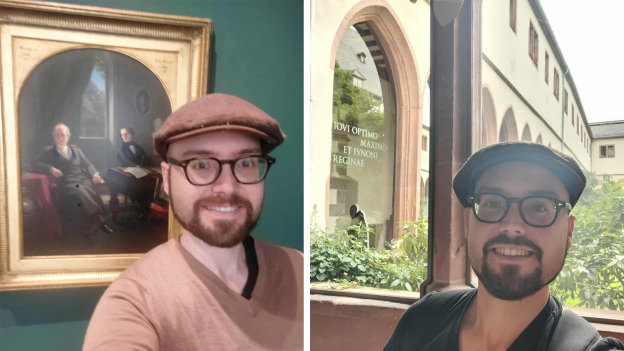
At the Institut für Stadtgeschichte and the Jewish Museum
I had previously been in contact with Dr. Michael Klaper in Jena and, in Frankfurt, with the cultural historian Dr. Rebekka Voß; both had generously offered guidance and provided invaluable orientation for archival research in Germany. During this trip, at Wolfenbüttel, I consulted rare editions of Christian Hebraists such as Johann Jacob Schudt, analyzing their representations of Jewish ritual and liturgical music within broader debates on tolerance, alterity, and civic order.
I also participated in a research seminar at the Herzog August Bibliothek, which allowed me to present preliminary findings and refine my methodological approach through feedback from colleagues. I also made a research visit to the Institut für Stadtgeschichte Frankfurt, where I examined seventeenth-century archival materials documenting Jewish communal life in the Judengasse.
Among the most remarkable discoveries were records from the 1670s–1690s detailing conflicts around wedding festivities, including episodes of sonic disruption and intra-Jewish disputes arising from dances gone awry. These sources shed new light on questions of ritual decorum, social hierarchy, and the cultural politics of sound within early modern Jewish communities.
Juergen Sack iStock.
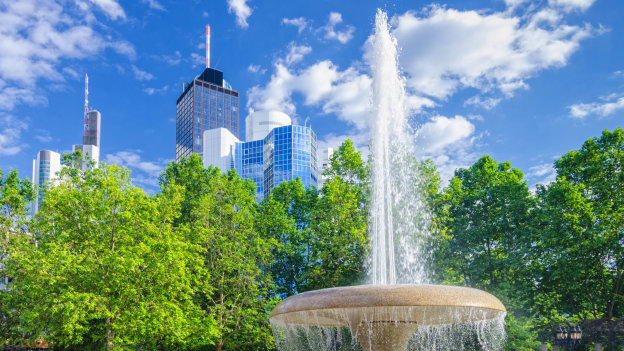
View at Frankfurt skyscrapers
These discoveries did not fold neatly into a single section of my dissertation but instead found their way into several places - especially in Chapters 1 and 2, where they help frame broader questions about sound, conflict, and cultural negotiation in Jewish life. At the same time, the archival material makes it clear that some of these findings deserve fuller treatment than a dissertation chapter can offer; I therefore plan to develop two separate articles from this research, one focused on Christian textual depictions of Jewish soundscapes and another on conflicts within the Jewish community itself—what I describe as “intra-Jewish sonic conflicts”—in late seventeenth-century Frankfurt.
In the latter case, the term refers to a protracted rivalry between two prominent and legally protected families living in the Judengasse. This specific conflict also unfolded in sound and spectacle: during wedding celebrations, members of one family staged nighttime masked dances that mocked their rivals, parading through the Gasse with music, torches, horses, and even drawn swords. What might appear as festive exuberance thus became legal battle over rivalry, involving public humiliation, intimidation, and allegations of physical violence.
My short time at Friedrich Schiller Universität Jena proved to be personally enriching. Although during the middle of the summer, I was welcomed into a research environment where conversations with faculty in Jewish Studies and Musicology sharpened the conceptual framework I bring to the study of early modern acoustic cultures.
Privat
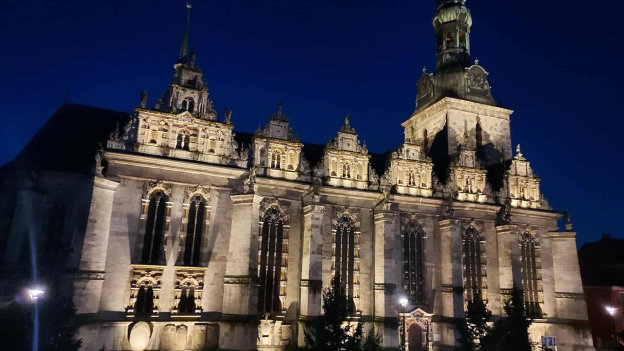
Marienkirche in Wolfenbüttel
In particular, discussions with Dr. Michael Klaper—whose work on musical itinerancy examines the mobility of musicians and repertories—encouraged me to think beyond individual musical works and instead trace the movement of people through corres-pondence networks. He suggested that I look more systematically at letters and other documentary traces to map patterns of travel, patronage, and exchange. This metho-dological shift has reshaped how I approach the question of mobility in my research.
The stay also enhanced my academic skills in tangible ways. I refined my command of German, especially in navigating seventeenth- and eighteenth-century manuscripts and printed texts, and expanded my scholarly network across Germany and beyond. Many of these encounters grew organically out of daily academic life: the Herzog August Bibliothek regularly hosted lectures and informal gatherings that facilitated sustained exchange with visiting and resident scholars.
Privat
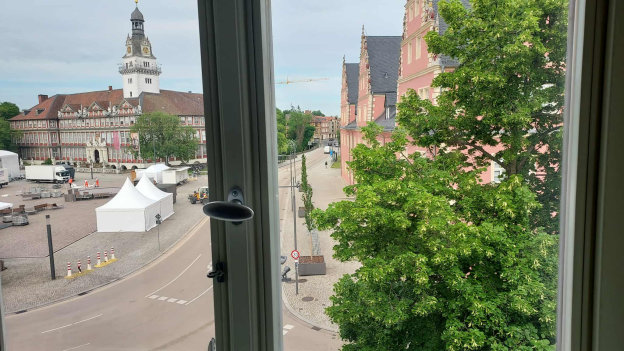
View from an office at the Herzog August Bibliothek
Through colleagues in Frankfurt and Jena, and even contacts in Essen, I was introduced to researchers at the Goethe-Universität Frankfurt am Main, with whom I met for coffee and lunch to discuss archival findings. On at least two occasions, I also undertook archival day trips to Hannover together with a musicologist from Bonn who was conducting research at the Herzog August Bibliothek. These professional interactions often extended into shared meals and informal discussions, forming the core of my social life during the stay and laying the groundwork for future collaboration.
Beyond the strictly academic sphere, daily life in Wolfenbüttel, Frankfurt, and Jena offered a deeply enriching immersion into German cultural life. In Wolfenbüttel, for example, I had the privilege of living in a remarkable seventeenth-century apartment overlooking the Hauptkirche Beatae Mariae Virginis. The elderly owner lived downstairs and often spoke with me in the mornings about music and the town’s history; he encouraged me to visit the Hauptkirche regularly, where Michael Praetorius had once worked, and to listen carefully to the organ and the new choir.
Those conversations, combined with the physical proximity to such a historic site, made daily life feel intimately connected to the period I was studying. By fortunate coincidence, neighbors in adjacent buildings were affiliated with the Herzog August Bibliothek, and we quickly developed a warm rhythm taking turns hosting dinners.
HAB Wolfenbüttel
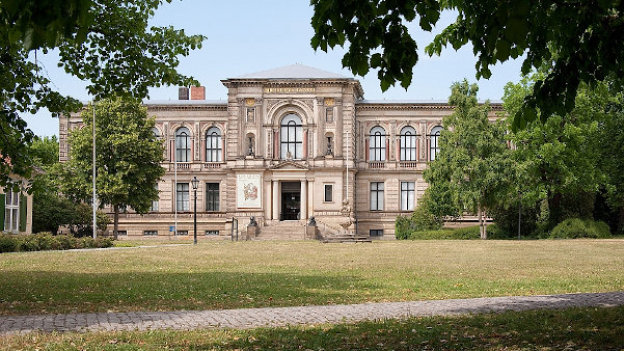
Herzog August Bibliothek
The library itself fostered both an intellectually focused and socially welcoming environment. After long days in the archive, colleagues and I often shared meals in town, and twice a week we gathered for a traditional Kaffeestunde, which became an important space of informal exchange. In the mornings, I would often walk along the Alter Weg toward Braunschweig before beginning work, passing through fields, open countryside, and also the old execution grounds.
Market days brought fresh strawberries of extraordinary quality, and I will never forget the rhubarb drinks near the Stadtgraben. The local bakers eventually recognized my regular order: Mohnkugeln and Ministerstreifen. In Frankfurt, my stay was somewhat more independent, yet I attended several church concerts in Sachsenhausen. Altogether, these experiences deepened my understanding of German society in ways that complemented and enriched my archival research.
The support of the DAAD-Stiftung, and in particular the generosity of Dr. Michael Aven, made possible a period of intensive research and the kind of intercultural engagement that can only be experienced by living and working abroad. This stay confirmed for me the intellectual and personal value of such exchanges, and I am profoundly grateful for the opportunity to contribute to and to learn from Germany’s scholarly and cultural life.
As of September 2025.