Janani Balasubramanian
 Privat
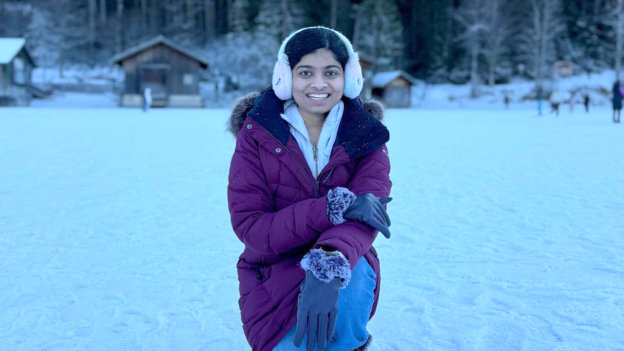
On the frozen Lake Eibsee during a trip to the Wetterstein Mountains in Bavaria
"Receiving the UNICORE Scholarship from the DAAD-Stiftung was a huge honor in my academic journey. Beyond expanding my research capabilities in spectroscopy, this experience immersed me in a culture of scientific curiosity, collaboration, and to experience life in Germany. I return with new insights, global friendships, and a deep sense of gratitude for the opportunity to grow both personally and professionally."
With the help of the UNICORE Scholarship by the DAAD-Stiftung, Janani Balasub-ramanian conducted research at the University of Ulm. Her scientific interests lie in nanomaterials and spectroscopy-based sensing, particularly in relation to their biomedical and environmental applications. During her time in Ulm, she was able to further her research into SEIRA spectroscopy. She also travelled around Germany, visited the Alps, marveled at the vast selection of cocoa products at the Chocolate Museum in Cologne, and enjoyed the occasional treat at a German bakery.
Research Focus and Achievements
My work at Ulm university focusing on Advancing Vibrational Spectroscopy for Rapid BioMedical Assay, built on my prior expertise in Surface-Enhanced Raman Spectro-scopy (SERS) developed during my Master’s research in Canada. At Ulm, I expanded into Surface-Enhanced Infrared Absorption (SEIRA) Spectroscopy—a complementary, FTIR-based technique with strong potential in biomedical diagnostics.
Over the three-month period, I focused on detecting and analyzing hemoglobin and cannabidiol (CBD) at varying concentrations using custom-fabricated substrates, particularly chemically reduced graphene oxide (rGO). SEIRA significantly enhanced vibrational signals—especially in the Amide I and II regions—providing detailed insight into protein folding.
Privat
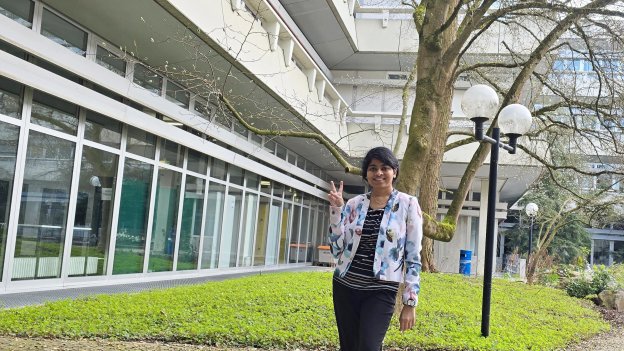
In front of the Institute of Analytical and Bioanalytical Chemistry at Ulm University
A key achievement was demonstrating SEIRA’s capability to detect CBD across a wide concentration range (nanomolar to millimolar). The rGO showed enhanced detection than commercially procured graphene. I successfully validated the technique on spiked beverages like tea, coffee, beer, and sparkling water—highlighting its promise for on-site diagnostics in biomedical and forensic contexts.
To optimize analytical sensitivity, I evaluated various optical configurations—ATR, transmission, and reflectance modes. This comparative study not only refined detection accuracy but also laid groundwork for future SEIRA-based point-of-care devices. I brought home a validated methodology for CBD detection across complex matrices and valuable insights into optical mode optimization, which I will now apply to the develop-ment of hybrid SEIRA-SERS sensors for realworld diagnostics. My next steps involve integrating these findings into my doctoral thesis and initiating collaborative publications with my German and Canadian mentors.
Academic Interactions and Networking
Working under the mentorship of Prof. Boris Mizaikoff and the daily guidance of Post Doc Dr. Diellza Bajrami was immensely enriching. Their expertise in analytical chemistry and nanophotonics helped sharpen my technical skills and broaden my scientific perspectives.
In February, I had the privilege of presenting my Canadian and Ulm-based research progress at an inter-institutional meeting at Institute of Analytical and Bioanalytical Chemistry (IABC), fostering stimulating conversations with peers and faculty across institutions.
Privat
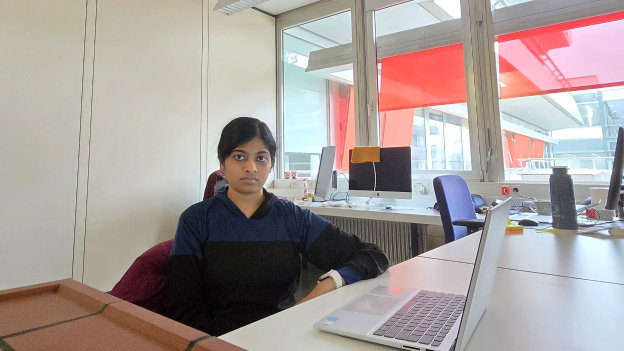
At my workplace
A serendipitous highlight was the in-person collaboration with my Canadian Ph.D. supervisor, Prof. Nisha Agarwal, who was also in Germany under a separate DAAD initiative. Together, we aligned our international goals, fine-tuned protocols, and explored joint publication opportunities - an invaluable addition to my graduate training.
Cultural Immersion and Life in Germany
Arriving in Frankfurt on January 2, I began my German journey with a scenic ICE train ride to Ulm. I spent my first days navigating local transport, identifying nearby essentials, and easing into my new environment, during the new year holiday. Life in Germany offered a refreshing perspective. I appreciated the cultural emphasis on work-life balance, the respect for quietude on weekends, and the efficiency of public infra-structure. I also had a chance to learn few German words while connecting with people.
Privat
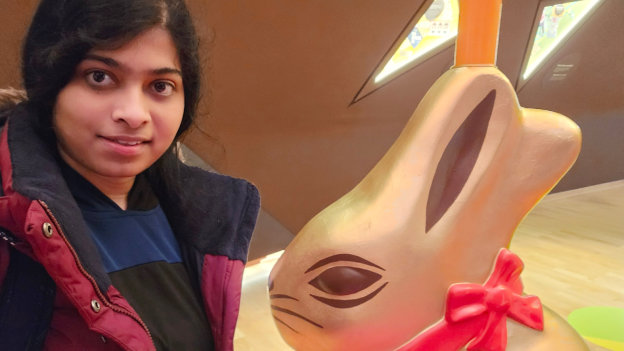
At the Lindt Chocolate Museum in Cologne
Memorable personal experiences included: Riding the rope car to Zugspitze, Germany’s highest peak at 2,962 meters—a thrilling adventure that offered breathtaking panoramic views of the Alps and a rare chance to experience snowcovered landscapes during my winter stay. Visiting the Lindt Chocolate Museum in Cologne was an awesome experience for a lifelong chocolate enthusiast like me. I explored the history of chocolate-making and even witnessed real-time production of artisanal treats.
Privat
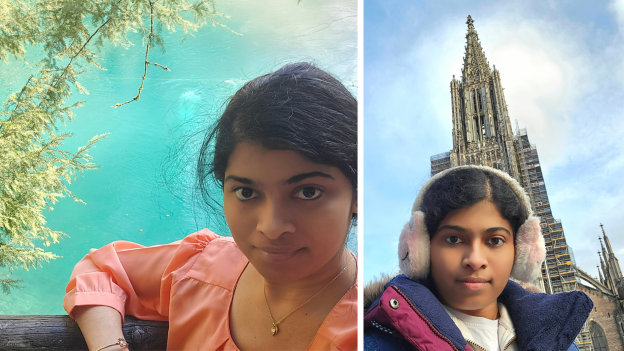
Visiting the Blautopf in Blaubeuren and the Ulm Minster
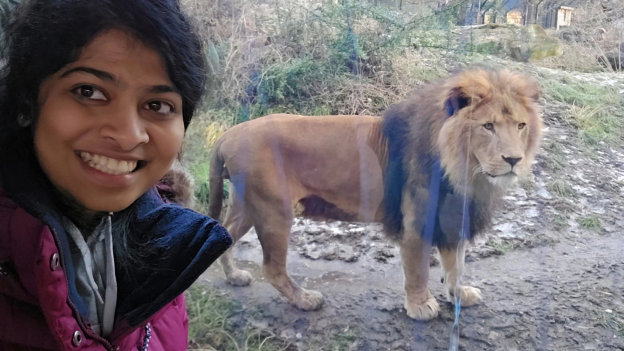
Exploring Blautopf, the mystical blue spring in Blaubeuren, was so peaceful to visit. The vibrant turquoise waters and legends surrounding it made the visit both scenic and magical. At the Munich Zoo (Tierpark Hellabrunn), I admired the thoughtful design of naturalistic habitats and first time witnessed Giraffe, lion, polar bear, etc.,.
Celebrating Holi with the Indian diaspora in Ulm created an emotional connection to home. We danced, shared traditional sweets, and laughed together—it was a beautiful fusion of cultures and a moment of pure joy during my stay. Enjoying German bakeries and seasonal treats added a delicious dimension to my journey.
Privat
Lion at the Tierpark Hellabrunn
This DAAD-Stiftung funded research stay elevated both my scientific and personal growth. It sharpened my hands-on experimental rigor, expanded my analytical toolkit, and introduced me to a vibrant research ecosystem in Germany.
The exposure to SEIRA spectroscopy and international mentoring has directly influenced the next phase of my doctoral work. I plan to integrate SEIRA into my thesis research, developing hybrid optical sensors for detecting hemoglobinopathies and cannabinoids in clinical and environmental samples. More importantly, the collaboration bridges I built—between Canada and Germany— will continue through co-authored publications, conference participations, and possibly, future joint funding applications.
I extend my heartfelt thanks to the DAAD-Stiftung for believing in young researchers and for creating avenues for global scientific exchange. This experience has strengthened my vision for impactful, interdisciplinary research and left me with lasting friendships and unforgettable memories.
------------------------
The research findings that Ms. Balasubramanian gained during her time at Ulm university have now been released, as she kindly informed us in June 2026:
"I am happy to share that the research work I carried out in Germany during my DAAD-Stiftung-supported research stay has recently been published in ACS Applied Nano Materials titled "Reduced Graphene Oxide for Surface-Enhanced Infrared Absorption Detection of Cannabidiol in Beverages"."
As of April 2025.