Leonie Embacher
 Privat
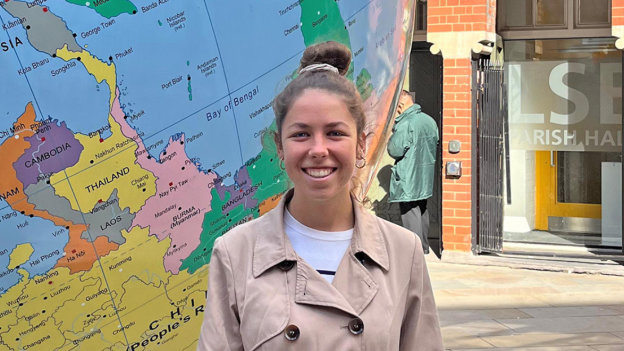
Leonie Embacher in front of the LSE building
“The DAAD-Stiftung’s Alexander Spohn Scholarship enabled me to study at my dream university, where I was not only academically challenged and able to learn an incredible amount, but also developed on a personal level. It gave me the freedom to fully immerse myself in my studies and in life in London – an experience for which I am very grateful.”
Supported by the Alexander Spohn Scholarship of the DAAD-Stiftung, Leonie Embacher successfully completed a master's degree in Social Data Science at the London School of Economics. Her master's focused on investigating social phenomena using data analysis tools as well as data evaluation. During her studies, she not only acquired knowledge of new methods for analysis but also e.g. gained insights into the structural differences between German and English universities.
After completing my bachelor’s degree in economics at Ulm University, where I discovered my interest in statistics and data science, I decided to apply for a master’s degree in Statistics (Social Statistics) at the London School of Economics and Political Science (LSE). After graduating in December, I first completed an internship and travelled through Southeast Asia for two months before moving to London in September to begin my studies there.
I chose LSE above all because of its distinctive master’s programme, which combines statistics with social and socially relevant topics. This combination of subject matter was unique and was a perfect way for me to build on my bachelor’s degree. I also wanted to do my master’s degree abroad, and London seemed the ideal place to study, with its renowned universities and its cultural and international flair.
Privat
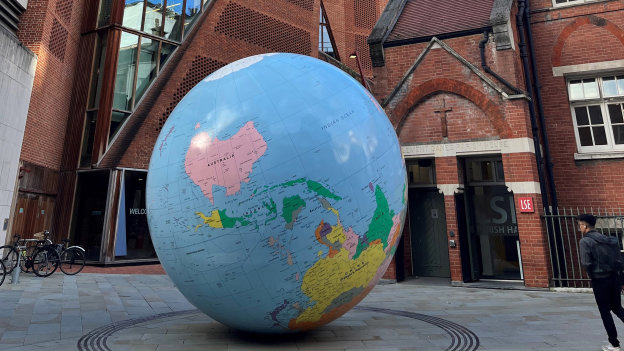
LSE Campus
I was able to study at LSE from September 2024 to June 2025. The programme differs from studying in Germany in many respects. The academic year is divided into three periods: autumn term (September to December), winter term (January to March), and summer term (April to June).
Each term comprises eleven weeks, including a Reading Week, which can be used for revision. Lectures take place only in the first two terms; the third term is set aside for exams and assignments. At first this structure was unfamiliar, as exams often take place months after the lectures have finished.
Looking back, I prefer the German system with two longer semesters, as the exams are usually completed by the end of the semester and you can then concentrate fully on new subject matter. But the LSE system has advantages, too: since people think in terms of academic years rather than semesters, once an academic year is complete there is free time from June to September, which is especially useful at bachelor’s level for internships or travel.
Privat
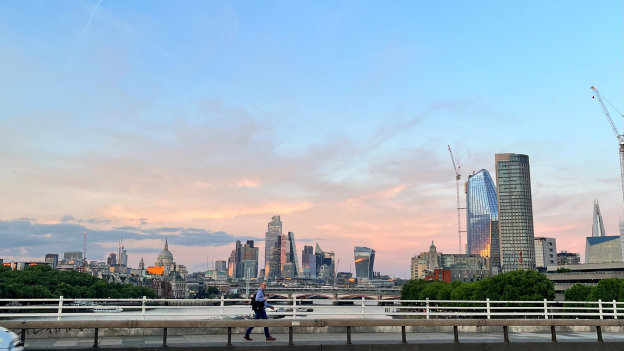
London Skyline
Assessment at LSE is varied and does not consist solely of exams, but also includes essays, online tests and, as in my case, data-based projects. In my mathematically oriented degree programme, exams make up around half of the assessment, as essays are less common. The other 50 per cent consists of projects and smaller tests.
I found the grading system particularly rigorous: you need at least 50 out of 100 points to pass, while a mark above 70 is already considered very good. Marks above 70 are rare, because the exams are designed in such a way that even well-prepared students are generally unable to answer all questions in full.
At first I found this kind of assessment unsettling, because you go into an exam knowing that there will be tasks which you simply have no idea how to solve. But the system also encourages you to focus on the key content rather than simply aiming for full marks.
Privat
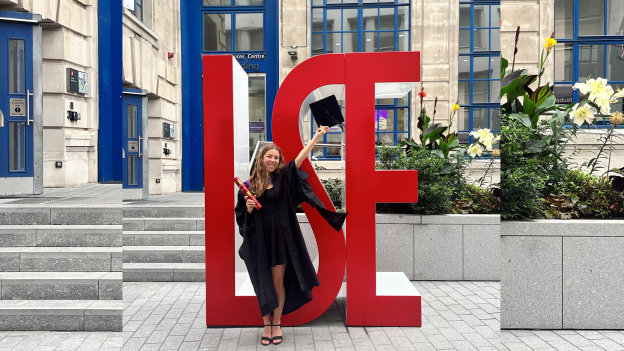
Graduation
A typical day at university was usually fairly long and structured around lectures, classes and independent work. I completed most of my work on campus, as the study atmosphere there was very pleasant and there were a lot of quiet places to work.
LSE is located right in the centre of London, which is practical on the one hand but also rather expensive, especially when it comes to food. There is a canteen, but prices there are quite high, with a meal costing around £4.
For this reason, I frequently opted for alternatives, such as the many nearby supermarkets offering so-called “meal deals” consisting of a sandwich, a snack and a drink for around £4. All in all I felt very much at home on campus and spent a great deal of time there. But I didn’t only work there, I also met friends for lunch or to study, or rounded off the evening in one of the LSE pubs.
Experiences beyond academic study
What positively surprised me most in London was that almost all museums offer free admission. That meant I was able to visit many of the best-known museums, and even on cold winter weekends I always had something interesting to do. One particular cultural highlight was a ballet performance at the Royal Opera House.
Public transport was rather a negative surprise. The Tube is very expensive, and buses are often slow and unreliable. As a result I decided to cycle to university. That saved me time and enabled me to get some exercise, too.
London is surprisingly cycle-friendly, and although the weather was occasionally a bit rainy, I only rarely took the bus because that would have meant that instead of a 30-minute bike ride I would have been travelling for an hour. My route followed the Thames, and each day I cycled past Big Ben and the London Eye, which was always something of a highlight.
Privat
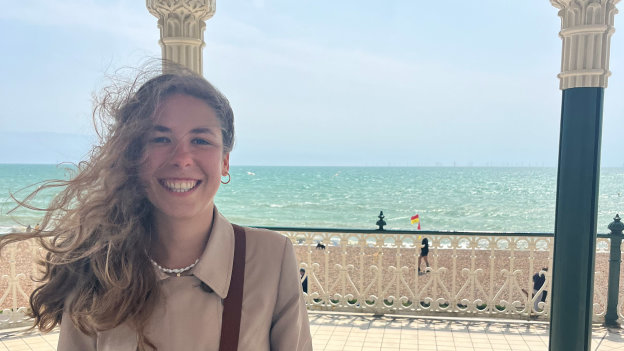
In Brighton
I also really liked the pub culture: it’s common to go for one or two drinks after lectures, and the atmosphere is always relaxed and informal. Arranging separate evening meetings is less common, however, as journeys can be very long. But pub culture gives you an easy and pleasant way to end the day with friends.
Beyond that, I explored many areas of London with my flatmates and fellow students. I particularly liked the north of the city, including Camden, and also Richmond. But I enjoyed visiting small English cities such as York and Cambridge, too, so as to get a sense of “classic England” beyond the big city.
Cultural diversity and personal development
Most of my friendships developed through the university, especially with fellow students doing the same degree programme as me. I often went to the pub or out in the evening with my best friend, and through him I also got to know many of his friends from his bachelor’s degree programme. I got on very well with my flatmates, too, so I quickly built a great social circle.
The international atmosphere at LSE was incredibly enriching. My fellow students came from all over the world, including Sri Lanka, Mexico and Argentina. I found conversations about different political and social issues particularly fascinating – for example the situation in Argentina and finding out about cultural differences in everyday life. One highlight was an evening together at a Sri Lankan restaurant, where a Sri Lankan fellow student gave us an authentic insight into Sri Lankan cuisine.
Privat
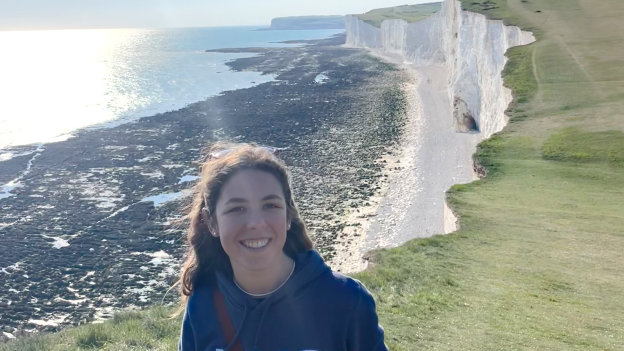
Trip to the "Seven Sisters"
I very much hope to maintain the friendships I made during my studies beyond my time in London. The fact that my friends come from so many different countries makes regular meetings more difficult, of course, but at the same time it gives me the possibility of travelling through lots of different countries with a personal “guide” one day.
Looking back, I feel that my experiences in London helped me grow not only academically but also personally. The combination of a demanding course of study, cultural diversity and the challenges of everyday life in a big city like London helped me become more flexible and independent, and it also taught me a great deal about myself.
What was especially valuable was the development of my English – not so much in a technical sense, but above all in terms of my confidence in using the language. Since I spoke English almost exclusively for nearly a whole year, it became second nature to me. The programme also enabled me to advance intellectually, of course: I learned a great deal and was challenged both academically and methodologically.
During this time, my ideas about my professional future also became clearer: after completing my doctorate, I can well imagine going abroad again for a few years – perhaps even returning to London.
All in all I had a truly wonderful time in London and at LSE, and I can warmly recommend studying there to anyone.
As of July 2025. The German version is the original.