Kathrin Kuhn
 Privat
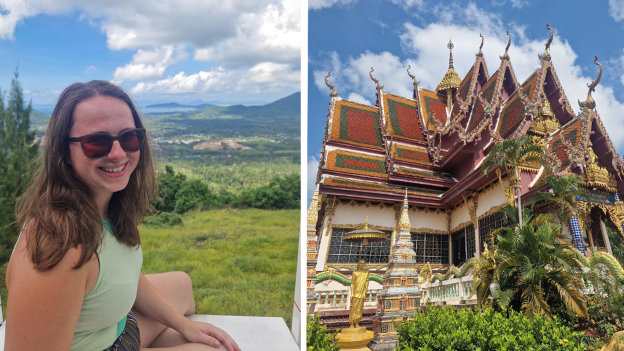
On a trip exploring Thailand
"Thanks to the Alexander Spohn Scholarship offered by the DAAD-Stiftung, I was able to spend a semester abroad at Chulalongkorn University in Bangkok. Academically, the experience was highly valuable, as it allowed me to expand my knowledge of Asian economic topics. On a personal level, too, the stay had a lasting impact on me, as it made me more open-minded and culturally aware."
With the financial support of the Alexander Spohn Scholarship of the DAAD-Stiftung, Kathrin Kuhn travelled to Thailand in order to deepen her knowledge of corporate strategy and management at Chulalongkorn University in Bangkok. Below, she provides an account of her study experiences and the unique opportunity to gain a close insight into everyday life in Bangkok and Thai culture.
Since I had already spent a semester abroad during my bachelor’s studies, I knew that I wanted to have a similar experience during my master’s programme.
Through the DAAD-Stiftung’s Alexander Spohn Scholarship, I not only received very good support but also excellent guidance.
Lohmann/DAAD
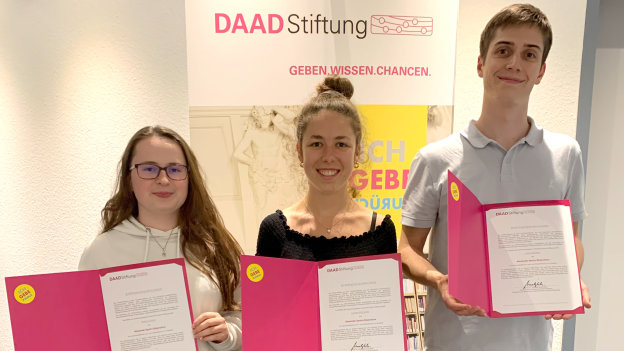
With other DAAD-Stiftung beneficiaries at the pre-departure seminar in Bonn
I arrived one week before the start of the semester in order to settle into the Bangkok metropolitan area. As I plan to work internationally in the long term, this provided an opportunity to place a stronger focus on Asia in my academic profile. In addition, the programme content was highly practice-oriented – something that had been somewhat lacking during my bachelor’s studies. I arrived one week before classes began to give myself time to adjust. It was not until I left the airport that it truly hit me: this would be my home for the next few months.
My first few days in Bangkok were marked by a sense of wonder as I spent most of the time pursuing typical tourist activities and searching for accommodation. Before travelling, I had already researched possible housing options, but I did not want to sign anything from abroad without viewing it first. For this reason, I spent the first few days in a hotel and searched for accommodation locally – something I would definitely recommend.

Privat
Bangkok Skyline
Many students stayed at Nonsi Residence, but I found it to be too far from both the city centre and the university. Most landlords require a minimum rental period of one year. Listings can primarily be found on Facebook Marketplace or on the “Line” app.
It is important to view apartments in advance to ensure they meet expectations, as online listings often differ from reality. Overall, the cost of living is significantly lower than in Germany, and it is possible to live very comfortably. Since I had planned from the outset to travel extensively, I deliberately looked for something simple and chose a student room at CU iHouse. The proximity to the university and the flexible rental terms were key deciding factors.
Privat
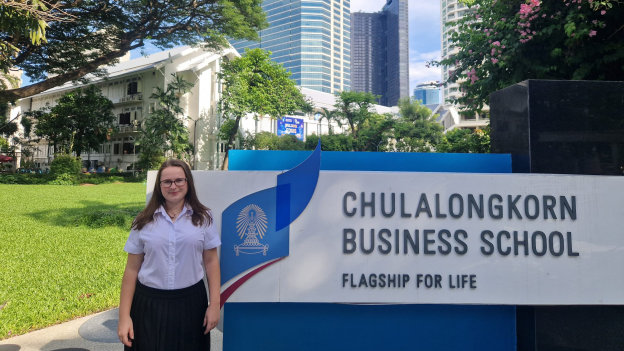
Chulalongkorn Business School
Before the official start of classes, there was a helpful orientation event for international students, which also made it easier to make initial contacts. There were a lot of students from European countries, and valuable friendships developed during this time, many of which I have maintained to this day. We also received important organisational information. For example, it was straightforward for us to change courses during the first two weeks.
I took six courses: Financial Strategy, Digital Business Strategy, Global Business Strategy, Global Business Environment, Project Management and Supply Chain Management. I was very satisfied with all of them. What I particularly appreciated was that the classes were interactive, discussion-based and highly practice-oriented. Unlike at many German universities, participation formed part of the assessment (usually around 5%). There were also weekly case studies, presentations and group work. The group work in particular was highly instructive for me, especially from a cultural perspective. I noticed that I tend to speak quite clearly and plainly in discussions – something that was not always well received.
A lot of the Thai students were much more reserved and tended to avoid confrontation. Communication is often indirect, and much remains unspoken. For me, it was a valuable experience to observe and take these differences into account. This is something that will be particularly helpful for me in an international working environment in the future. I also learned a great deal about the Asian economy, with a particular focus on China and Southeast Asia. For example, we examined the Asian financial crisis of 1997–1998 and its economic consequences in depth – a topic I previously knew very little about.
Privat
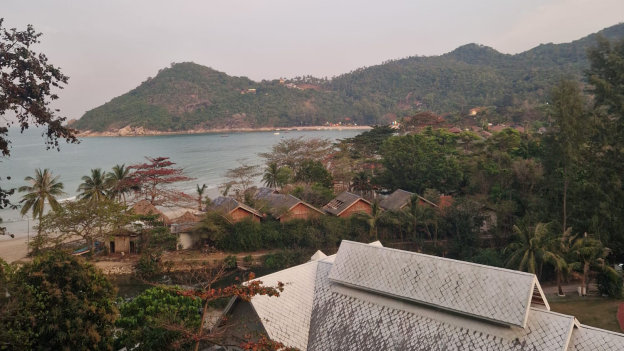
View on the beach
I also found the direct access to professors to be very positive. Questions were encouraged, and feedback was constructive and appreciated. Assessment typically consisted of several components: continuous participation, case studies, group projects and a final exam (40%–60%). At my home university in Germany, I was more used to a single final exam at the end of the semester, but I quickly adapted to the regular assignments throughout the term. There were stressful phases too, of course, but spreading the workload across the semester made exam preparation much easier.
A typical class lasted three hours. Although there is a timetable, professors regularly reschedule sessions. Courses require preparation and are designed so that the content is summarised and discussed during class. The lunch break lasted one hour, so we had plenty of time to eat in the canteen or visit one of the two nearby shopping malls. The food options were diverse and plentiful. There is something for everyone, and it’s easy to try different dishes.
After class, there was usually a graded assignment (e.g. a case study) related to the topic covered in class. 80% attendance is required, otherwise the course is considered failed. I can highly recommend the university’s free Thai language course. Overall, I would rate the workload as being lower than in Germany.
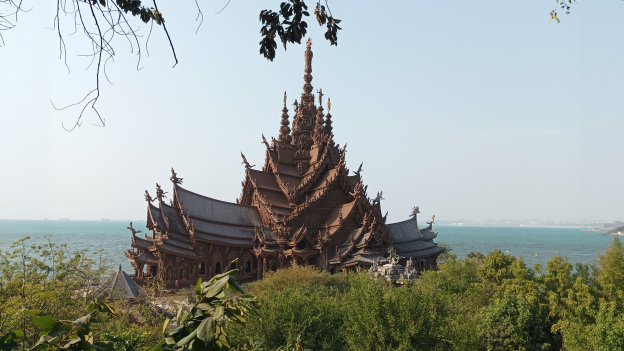
Privat
Temple at the coast
Outside the university, Bangkok and Thailand in general have a great deal to offer. I often met friends for a classic pad Thai or a smoothie. Bangkok is a city of contrasts and there is lots to explore: modern skyscrapers alongside ancient temples, quiet parks next to chaotic traffic, wealth alongside poverty. I spent a lot of time walking and visiting temples, parks, shopping centres and rooftop bars. The city is also well connected, making it easy to explore new places by bus, train or plane.
The university also offers a wide range of sports courses, so I would often spend time at the swimming pool or playing table tennis. This was also a great opportunity to connect with Thai students. I received numerous visits from friends and family from Germany, too, and was able to show them the city.
I took every opportunity I could to travel within the country. In the north, I visited the mountains around Chiang Mai, while in the south I explored the beaches of Krabi and Koh Tao – turquoise water and long white sandy beaches. But Thailand also has much to offer beyond the typical tourist destinations. I would often rent a scooter and simply set off to explore.
One unforgettable experience was encountering a small group of elephants in the wild, completely unexpectedly by the roadside. It was incredibly impressive to observe these animals in their natural habitat. In general, I rarely travelled alone, instead spending most of my time travelling with friends or in larger groups. But travelling alone is worthwhile too, as it is easy to meet open-minded people and make connections. I always felt safe.
My encounters with people in Thailand left a lasting impression on me. Even though not everyone spoke English and my own Thai was limited, I always felt at home. I experienced life in Thailand as more relaxed, slower-paced – but no less intense. I was able to make friendships that have lasted beyond the semester. Engaging with fellow students from Vietnam, Japan, the United States, France and of course Thailand left a lasting impact on me. We are still in contact today.
One especially memorable experience was the Songkran New Year festival in April, which is celebrated over several days. The entire city turns into a joyful water festival: families, children, tourists, old-age pensioners – everyone takes to the streets, splashing each other with water and having fun. Given the warm temperatures, the water is refreshing, but it also symbolises a fresh start to the new year.
Thanks to the Alexander Spohn Scholarship offered by the DAAD-Stiftung, I had the opportunity to spend a semester abroad at Chulalongkorn University – and it was one of the best decisions I have made. I grew not only academically, but above all personally. I learned to engage with new cultures, ways of thinking and lifestyles. I would strongly encourage anyone to take advantage of such an experience.
As of July 2025. The German version is the original.