Morgan Botrel
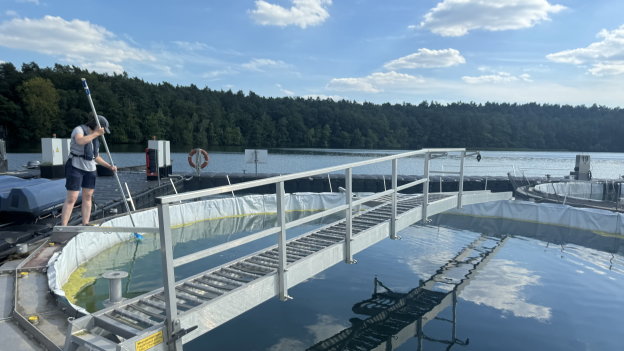 A. Petruzella
Scoping out floating algae at the LakeLab
"A valuable experience scientifically but also for my family that joined me for the trip, the KSB Stiftung Scholarship by the DAAD-Stiftung made possible a visit to a close collaborator and getting immersed in the rich German culture."
Freshwater is one of the most precious resources on Earth. Yet it is scarce and often contaminated. Native aquatic vegetation plays a crucial role in maintaining the health of freshwater ecosystems by providing clear water, retaining nutrients and storing carbon. However, invasive alien aquatic plants can outcompete native vegetation.
With the support of the KSB Stiftung Scholarship from the DAAD-Stiftung, Morgan Botrel researched on efficient strategies for containing and sustainably managing invasive aquatic vegetation. As well as conducting several successful experiments at LakeLab in Berlin, she also experienced German traditions, culture and everyday life, in which cake is never far away.
An afternoon tea with a German family gathered around a table with seven different cakes, that is how I spent the first day of my short-term research stay in Berlin. That was a good introduction for the days to come as I always felt very welcome, was gladly immersed in German culture, and cake was never very far!
The family on that first day was that of Dr. Sabine Hilt, the researcher whom I came to visit at the Leibniz-Institute of Freshwater Ecology and Inland Fisheries in Berlin (proud to say that I can say this in German now). Dr. Hilt and I had been collaborating from the distance since the beginning of my postdoctoral research in 2023. As a long stay abroad was not possible before due to family responsibility, I am very grateful for the DAAD-Stiftung support that allowed me to visit Dr. Hilt and further our collaboration.
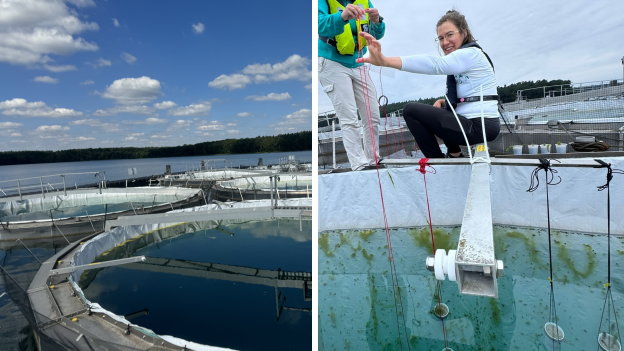
Jens Nejtsgaard
Deployment of the plants
Indeed, my stay was very fruitful in deepening ties with Dr. Hilt but also in developing new relationships. The project we worked on was an experiment in LakeLab, a unique facility at IGB consisting of 24 enclosures of 9 m-diameter and 20 m-depth.
While I was working from the IGB department 2 (community and ecosystem ecology) in Berlin, the enclosures were placed in lake Stechlin, a very large and clear lake in Neuglobsow (about 1:30 hour drive north of Berlin) along the shore of which is installed IGB department 3 (plankton and microbial ecology). In a subset of these enclosures, we hung ropes with attached cups at different depths in which we planted aquatic plants. We selected the enclosures so that they varied from low to high light transparency and nutrient availability. The idea was to determine what conditions favored an invasive aquatic plant compared to a native one. We measured this by following plant growth and the water environment.
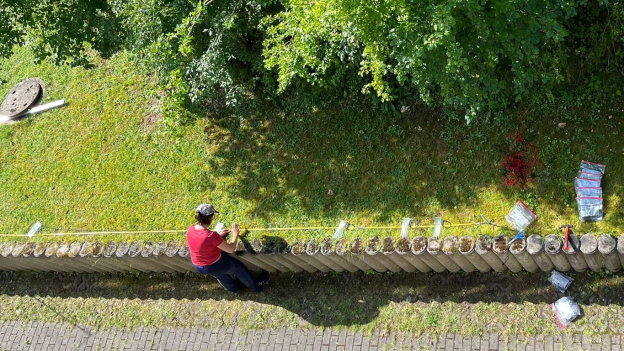
Stella Berger
Preparing and measuring out the ropes for the experiment
The experiment was definitely a success because it was a collective effort. I was teamed up with a new postdoc working with Dr. Hilt, Dr. Antonella Petruzzella, who ran the same experiment as I did but with two different species. As this was my first experiment, her expertise was instrumental in getting our plant set up and ready for deployment. LakeLab being a very large facility, we were also really fortunate to be accompanied by the two LakeLab coordinators, Dr. Stella Berger and Dr. Jens Nejtsgaard.
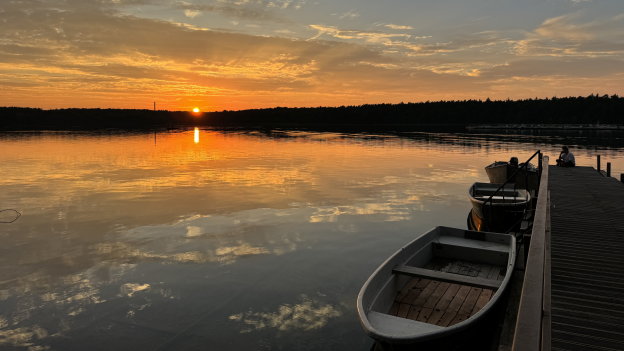
Privat
Sunset on the department 3 dock in lake Stechlin
Under their coordination, sensors were deployed in each enclosure to measure continuously different water parameters. We could also collect water to measure other parameters that were analyzed in department 3 laboratory. With the help of Dr. Berger and Dr. Nejtsgaard, we, Dr. Hilt, Dr. Petruzzella and I, were able to select enclosures based on a thorough analysis of water parameters and we had a sturdy set-up that could hold our plants in place for four weeks.
Dr. Berger and Dr. Nejtsgaard even brought in another postdoc specialized in remote sensing, Dr. Igor Ogashawara, to work with us and look at the effect of light quality on the different aquatic plant species. Of course, we also benefited from the help of all the Lake lab staff and Dr. Hilt’s group, without whom the deployment, sampling and harvest could not have taken place. Most notably the help from Armin Penske, Christine Kiel and Julia Scheunert was instrumental in completing the experiment.
Now that the experiment is finished, we are working on the last laboratory analyses, compiling data, running statistical analysis and writing a manuscript. For the moment, we see that the invasive species prefer the combination of lower light intensities and higher nutrients. Compared to the native species, they grow more roots with increasing depths. I am confident that we should have at least one scientific article completed by next winter.
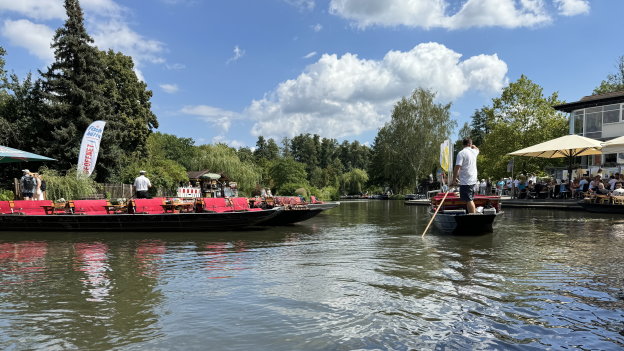
Privat
The port of Lübbenau in the Spreewald
Both, when I was staying in Berlin and when I was working on the experiment in Neuglobsow, I experienced the cultural difference with my daily life in Canada. I visited different parts of Berlin as I stayed in Schöneiche, Altglinieke, and Schöneweide, first with Dr. Hilt family, then with my spouse, two kids and niece, and finally by myself.
I appreciated how water was very present and accessible in Berlin with the many lakes and the Spree River. It felt almost as living in the countryside sometimes, especially when I was going around by bicycle to work through Köpenick and my family spend their days at the beach.
I got the chance to visit different museums in Berlin and also markets. I really appreciated the Alte Nationalgalerie, where I discovered the art of Caspar David Friedrich, the East Side Gallery and the Jewish Museum (two must sees in Berlin), and also the Kollwitzplatz farmer market. I was surprised by how easy it was to find vegan or vegetarian options in Berlin, particularly Turkish dishes, which is far from the stereotype of sauerkraut and sausage. There were actually more options than back home, even vegan schnitzel could be easily found. Apart from the cakes, I miss the diverse choice of Brötchen (little bread) from the Bäckerei that are everywhere to be found in Berlin.
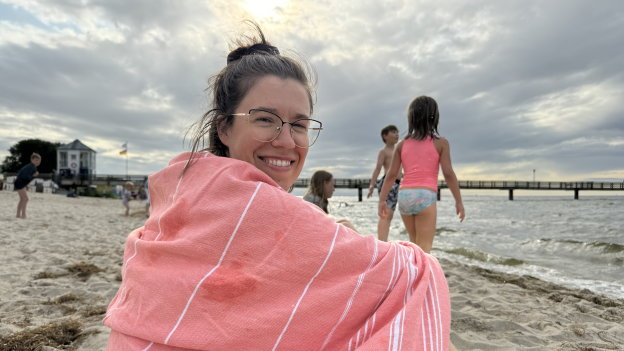
Tommy Pinard
At the beach in Lubmin along the Baltic Sea
I also got the chance to attend festivals and take weekends to visit places around Berlin. I saw the International Barrel Organ Festival in Prezlauer Berg, and saw a Jazz concert along the Spree River at Schöneweide.
With my family, I visited Potsdam, Dresden and the Basteibrücke, the Baltic, and also the Spreewald that is kind of a German Venice with pickles (local specialties that are delicious). I know that while I was working, my family enjoyed the many kid-friendly museums (botanical garden, zoo, Technikmuseum…) and also the amazing Spielplatz (playground) all around Berlin. It really helped that we could easily commute using public transport that was affordable with the Deutschlandticket.
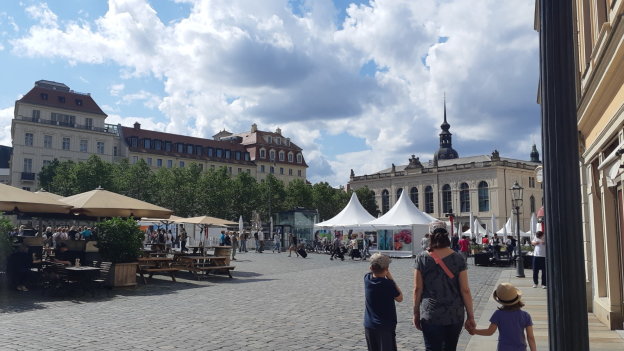
Tommy Pinard
In Dresden Altstadt, going for cake
At work, although differences were not so significant, they still went beyond the language singularities. Of course, there was always an excuse for a cake, particularly in Neuglobsow where coffee and tea break were sacred. I learned for example that when somebody is leaving or has their birthday, they throw their own party and make their own cake!
The opposite then back home. I also felt the difference between working in an institute compared to a university. While I am used to working with students that I train at the university, at IGB the staff was highly qualified, and technicians had a prominent role when it came to determining what can and cannot be done.
One other major difference of sampling in Canada compared to Germany was the way we got to our sampling site. While I am used to travelling to sampling sites by van or pick-up, it was the first time I got to travel by public transport for that purpose. Although this went generally quite well and is an environment-friendly way to travel, it was not always ideal in practice, for example, when I had to transport my food for one week or when during summer holidays trains and buses were cancelled…
Another nice piece a German culture I experienced was when I was on the dock in Neuglobsow, loading equipment to the boat we were taking to get to the enclosures. A naked man sitting on a submerged tree branch casually asked me: “Haben Sie die Zeit?” (Do you have the time?). I was told that as you go north in Europe, naturism is common; this is not something that I experienced before.
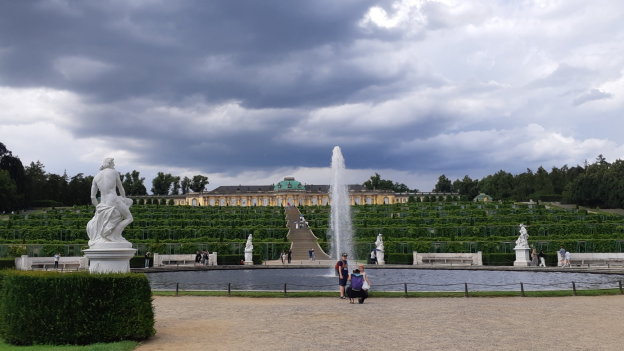
Tommy Pinard
The Sanssouci palace in Potsdam
All in all, what I will remember from my stay in Germany is the wonderful people I met. Yes, I learned technical skills on how to plan and run an experiment, even catching a glimpse on how large European project can be done.
But as I was told by colleagues, during scientific visits what we remember in the end are the people we met. These are connections that will be invaluable as I will become a professor next year. Hopefully we can build new projects and maintain a transatlantic collaboration that anchors in our trust of science and love of life.
As of October 2024.