Twaha Kateete
 Privat
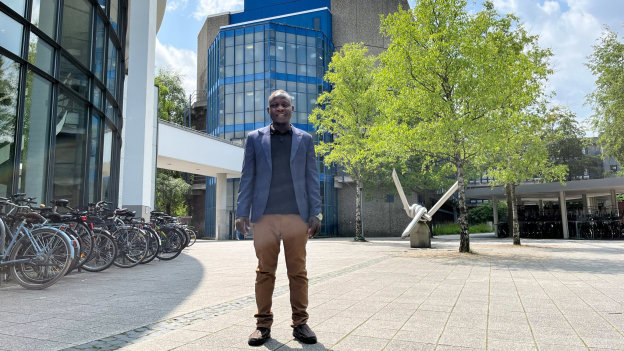
In front of the university in Oldenburg
„The DAAD-Stiftung Scholarship allowed me to advance my research in AI-driven energy analysis while gaining valuable German cultural exposure and international academic connections.“
In many remote areas around the world, access to electricity is not a given. Twaha Kateete's research project, funded by the DAAD-Stiftung's Schwarzwald Scholarship - made possible by a generous donor -, aimed to improve power supply in such areas. He analyzed usage data to predict patterns and optimize the operation of photovoltaic mini-grids.
Mr. Kateete was warmly welcomed by his research group at the University of Oldenburg and quickly became familiar with both professional and everyday life in Germany, as well as the word “Moin!”, which is quite important in the north.
From May to June 2025, I had the exceptional opportunity to undertake a two-month research stay at Carl von Ossietzky University in Oldenburg, Germany. This stay was made possible through generous support from the DAAD-Stiftung, and hosted by the Department of Computer Science, within the Research Group of Environmental and Sustainable Information Systems. I was privileged to work under the dedicated mentorship of Prof. Dr. Philipp Staudt, whose guidance and continuous support were invaluable throughout my time in Oldenburg.
The research project was centered on building a mini grids simulation model as close to reality as possible to be used in testing how the mini grids could react if consumption patterns change, grid stability is affected, when part of the grid fails, when batteries fail and when parts of the generation side are changing, within the 25 villages of Lamwo District in Northern Uganda.
Privat
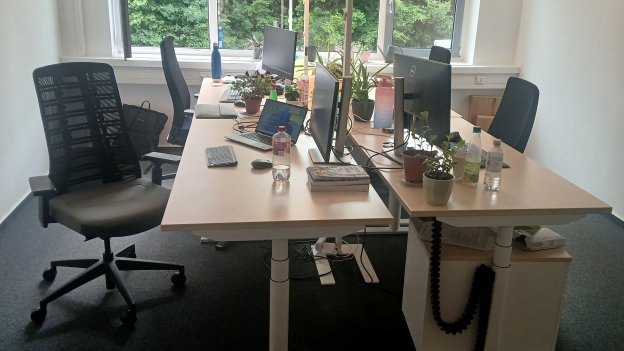
My office
Based on the clusters we developed from the consumption dataset of the households, it is evident that Evening Peak users mainly utilize electricity for lighting, phone charging, television, and radio, reflecting typical residential evening activities. Day-time Active users primarily operate small businesses, phone charging hubs, and sewing or retail shops, indicating productive daytime energy use.
All-Day Active users depend on electricity for refrigeration, water pumping, and contin-uous commercial operations such as clinics and shops, showing a steady demand throughout the day. Meanwhile, Low/Irregular users exhibit limited and inconsistent usage, mainly for occasional lighting and phone charging, suggesting infrequent engagement with the mini-grid system.
An initiative focused on data-driven energy optimization for rural off-grid mini-grids. This project allowed me to apply advanced data visualization and modeling techniques in a supportive, interdisciplinary research environment.
About the Research Project
The project is a collaborative initiative supported by DAAD-Stiftung, which funded my research stay in Oldenburg, in partnership with NOA Uganda Services, the Ministry of Energy and Mineral Development (Uganda), Carl von Ossietzky University of Olden-burg, and Ndejje University. It utilizes real-world energy consumption and generation data from 25 villages to optimize energy management systems for mini-grids.
During my stay in Oldenburg, we analyzed datasets downloaded from Sunny Portal and Thundercloud system with access provided by NOA Uganda Services, focusing on customer usage patterns and battery storage behavior. Our Data visualization and clustering performed revealed four major consumer cluster groups: 1. Evening Peak Users, 2. Daytime Active Users, 3. All-Day Active Users and 4. Low/Irregular Users.
Privat
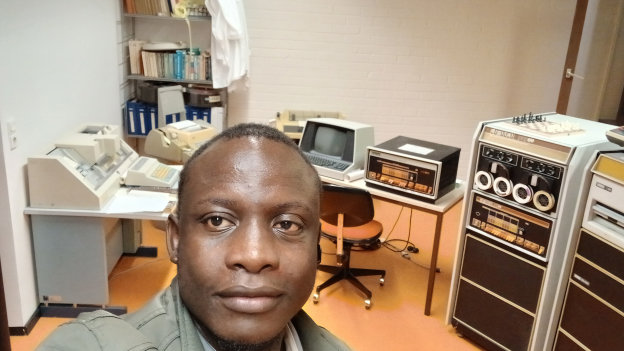
At the Computer Museum
We also analyzed days when the battery State of Charge (SoC) dropped below 5% and used linear regression models to understand the influence of PV size, battery capacity, and household cluster type. We found out that there is a relationship between the Battery Size and the drop below 5%. The insights gained during this analysis are to be used to inform AI-based load prediction and decision-making systems. The project is still in continuation to more understand how we can physically integrate what we found out to improve Mini-Grids Operations in Lamwo District of Northern Uganda.
Research Group and Social Experience
I was warmly welcomed into the Research Group of Environmental and Sustainable Information Systems, a vibrant and knowledgeable team within the Department of Computer Science. My supervisor, Prof. Dr. Philipp Staudt, offered invaluable mentor-ship, and the PhD students, Lea, Paula, Fabian, and Malte, played an integral role in giving me academic, social and practical assistance.
Socially, they helped me orient myself around the campus and city, integrate into German culture, learn basic language skills, and discover social events and interesting places to visit and get logistics.
Privat
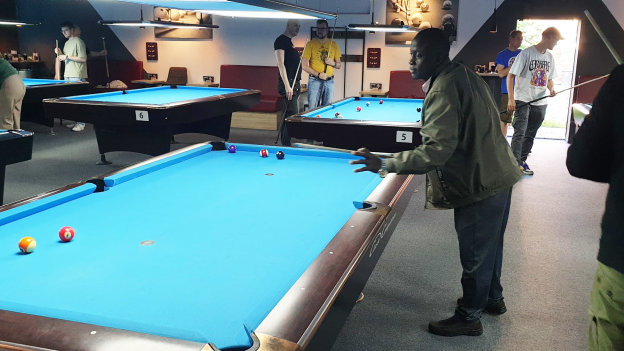
Billiard in Oldenburg
Academically, they guided me in analyzing NOA Energy data, preparing for project defenses, and managing research effectively through practices such as weekly project meetings. Practically, they offered advice on transportation options, assisted with technical issues, such as setting up internet connectivity, and during project model training. I found German people so welcoming and social.
Beyond academic work, I took part in exciting social events organized by the research group. These included enjoyable team gatherings with traditional German meals, engaging team games, and cultural exchanges that gave me a rich appreciation of German hospitality.
Privat
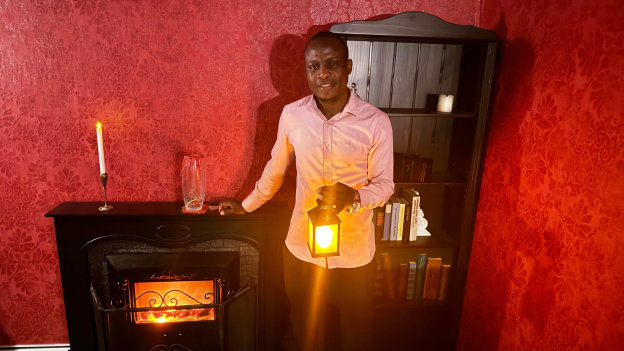
At the Escape Room
One of the highlights was our visit to Richters Sportwelt Billard and Dartcenter, where we spent an evening playing pool table and darts, a fun bonding activity with the team. In the second social event, I visited the Escape Room and in the same area, we played interesting games with the Team after our meal where I ate the German Avocado Burger.
Daily Life in Oldenburg
I stayed at the University Guest House at Wechloy Campus, which offered convenient access to both the research center office and public transportation (buses). My week-ends were filled with enriching explorations of Oldenburg's culture and landmarks.
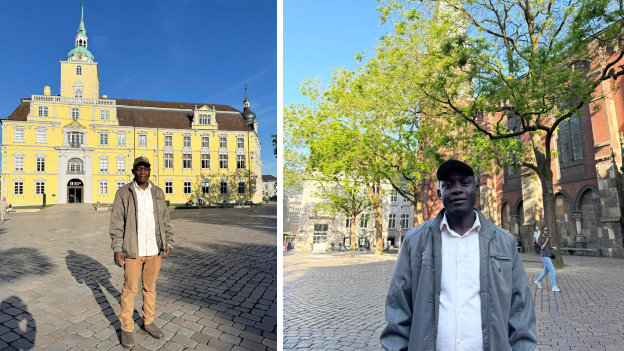
I visited: Oldenburg Castle (Schloss Oldenburg), a historical site with deep cultural roots, Lapan, a peaceful escape for nature walks and reflection, Saturday Markets at Julius-Mosen-Platz, vibrant with fresh produce, street food, and local crafts, Oldenbur-ger Computer Museum and Oldenburg Escape Room Point.
Privat
Julius-Mosen-Platz and Oldenburg Castle
I also enjoyed gadgets and grocery shopping at the MediaMarkt and supermarkets such as Combi and Edeka, where I discovered new foods, ingredients, and shopping experiences quite different from those in Ugandan supermarkets. This gave me a broader cultural appreciation and a new perspective on different electronics, food variety and packaging standards. I was impressed by a lot of bakeries in Germany, bread is more than what we have in Uganda. I was also impressed by the fact that new versions of electronics are sold in shops like for the case of phones, laptops.
Challenges
My first challenge was understanding the German language (But learnt “Moin” so quickly …hahaha), which occasionally created communication difficulties, especially in stores and public areas. However, I adapted quickly by using the DeepL translator, which allowed me to translate content into English and navigate my tasks efficiently.
Another challenge I encountered during the first week was navigating public transport, especially the city’s bus system. Initially, it was difficult to understand the bus schedules and routes, but with time, I learned to use the bus timing systems, improved my punctuality, and developed a reliable daily routine.
Conclusion and Acknowledgements
My research stay has been a defining moment in my academic journey. I would like to express my heartfelt thanks to:
- Prof. Dr. Philipp Staudt for his mentorship and support.
- The PhD team, Lea, Paula, Fabian, and Malte for their collaboration and friendship
- Mr. Alexander Thym, my DAAD contact person, for his constant communication, encouragement, and logistical guidance
- Ms. Stefanie Lohmann, my DAAD-Stiftung contact person, for her support throughout my stay at Oldenburg.
- International Office at the university for their support and guidance
- Carl von Ossietzky University for hosting me and providing a conducive research environment under its Department of Computer Science.
- NOA Uganda Services, for providing the project data.
- The Ministry of Energy and Mineral Development (Uganda) and Ndejje University, for their project collaboration and support.
- And most importantly, DAAD-Stiftung and my sponsor, for funding and making this transformative experience possible.
This stay has strengthened my technical skills, expanded my international academic network, and further motivated my commitment to sustainable energy solutions for Uganda and beyond.
As of July 2025.