Marta Posadzy
 Privat
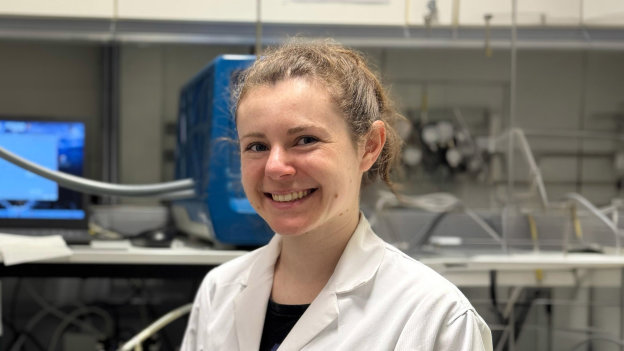
At the lab
„Thanks to the KSB Stiftung Scholarship, I had the unique opportunity to conduct a research stay at the Universität-Duisburg-Essen, in the group Technical Chemistry III. This stay abroad, supported by the DAAD-Stiftung, gave me the opportunity to develop both academically and personally and to gain valuable intercultural experience.“
Specialized in materials chemistry and engineering, Marta Posadzy was able to advance her research at the University of Duisburg-Essen with support of the KSB Stiftung Scholarship by the DAAD-Stiftung. She wrote her doctoral thesis on the electrochemical reduction of carbon dioxide, a field in which the university has an excellent reputation. During her stay, she made friends with other international and German students and explored not only North Rhine-Westphalia but also the Netherlands and Belgium.
I am a 2nd year PhD student at Wrocław University of Science and Techno-logy (Poland). I have been working in a research group that specialises in carbonbased materials for clean energy transition and storage, led by Prof. Piotr Rutkowski. In my PhD studies I focus on two-dimensional nanomaterials as electrocatalysts for electro-chemical reduction of CO2.
For my research stay abroad I chose the group led by Professor Corina Andronescu, because of its outstanding reputation for academic excellence and innovative research opportunities. The group specialises in electrochemical catalysis, focusing on electro-catalysts and electrode design for CO2 electroreduction, among others. I hope this stay will be the beginning of a longer collaboration between our research groups.
Privat
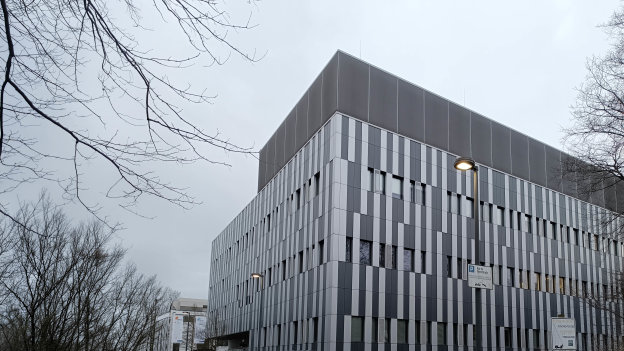
University of Duisburg-Essen
The main goal of the project was to investigate the performance of MXene-based catalysts in the electrochemical CO2 reduction. During the stay, I managed to assess the materials’ activity towards CO2 reduction, determining key reaction parameters, such as overpotential, stability, and selectivity for the generated products.
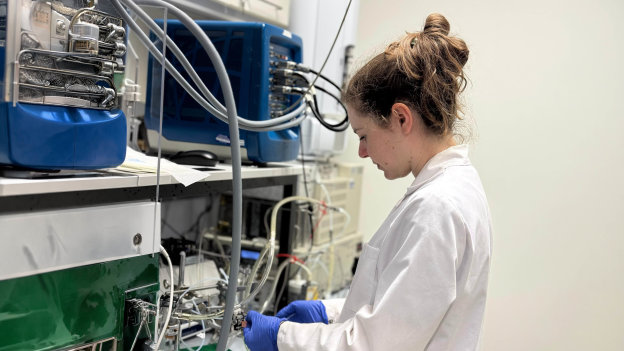
The electrocatalytic activity of the prepared catalysts towards CO2 reduction was measured in a three compartment cell, with catholyte, anolyte, and gas compartments. Then I performed chronopotentiometry experiments, stability tests and galvanostatic electrochemical impedance spectroscopy (GEIS). The selectivity of the catalysts was determined, using online gas chromatography to detect the gaseous products, while high-performance liquid chromatography was used to quantify the liquid products.
Privat
Test in the laboratory
Based on the collected data, I determined key parameters, such as reaction overpotentials, and faradaic efficiencies of the generated CO2 electroreduction products. I have also tried to optimise the materials’ performance by tuning the composition of the catalyst ink and catalyst layer hydrophobicity /hydrophilicity. The optimisation of catalysts for electrochemical CO₂ reduction could be highly beneficial to researchers and companies involved in sustainable energy and carbon management.
Industries such as carbon capture and utilization (CCU), renewable fuels, and green chemical production could surely profit. By improving catalyst performance we make CO₂ electroreduction more energy-efficient and economically viable. This supports the development of scalable technologies for converting captured CO₂ into value-added products like syngas, formic acid, or ethanol. This improvement contributes to reducing industrial carbon footprints and promoting circular carbon economies, aligning with global environmental goals.
While conducting the research, naturally I spent a lot of time at the university. This gave me the opportunity to make new contacts. I have made friends with students, PhD students and Post-Docs from all over the world, including Brazil, Ghana, India, Colombia, Italy, and Germany, of course.
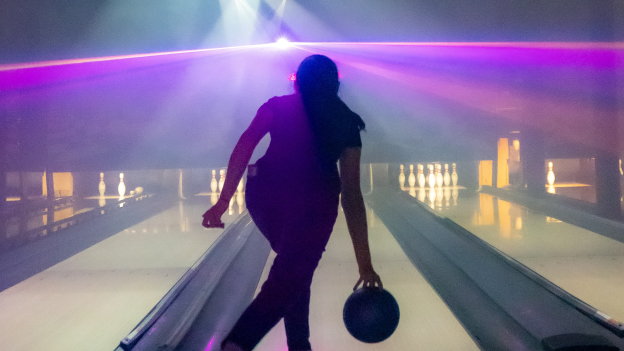
I was the only short-time exchange student at that time, all the group members were there for at least two years, but they were very welcoming. Every person I met at the university was very friendly, helpful and interesting to talk to. Although I was abroad for only three months, I feel like I have known them for few years at least, and I am still in touch with some of them. Apart from our daily lunches, we also spent time together outside of work, for example by going bowling or climbing. For any fellow climbers coming to Germany, I recommend Einstein Boulderhalle.
Privat
Bowling in Duisburg
I am very grateful for the time spent with fellow lab members because I didn’t know anybody in Duisburg before coming there for a stay. Additionally, my apartment was not a pleasant place to live in and I didn’t get along with my roommates so spending the free time outside was highly appreciated. Actually, I believe the accommodation was the hardest part of the whole experience.
The university offers the student accommodation for people staying at least one semester, so I had to find one on my own. I put a lot of effort into finding a proper one and sent what feels like a hundred messages but ended up paying too much for a barely acceptable room, to be honest. Maybe it would be easier if I spoke German.
Privat
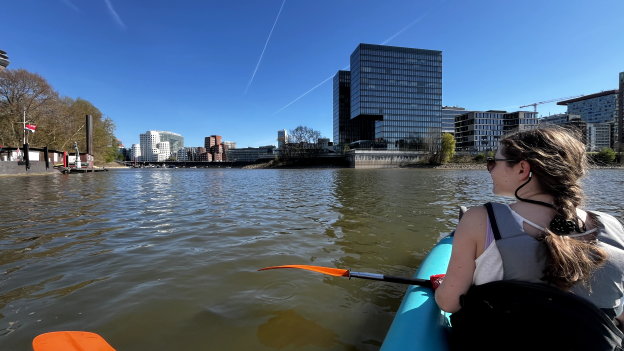
Kayaking in Düsseldorf
During the 3-month stay, I also managed to be a tourist, exploring the German region of Nordrhein-Westfalen. I have visited my family in Dusseldorf and I enjoyed a lot seeing Dusseldorf from a kayak. My friends from Poland came for a visit and together we went to Aachen, to see one of the oldest cathedral in Europe and relax in the Carolus Thermen.
I also took advantage of the region's location near the Dutch and Belgian borders to visit these two beautiful countries. With my Polish friends we went to Antwerp and Gent, we were really impressed by the architecture of Gent, it felt a bit like a trip to Hogwarts. My mom flew to Eindhoven for the Easter holidays and we were lucky to see the tulips field in bloom, also managed to wander around Amsterdam and eat stroopwafels.
In summary, I can say that my trip to Germany was an extremely fruitful experience. Also, I was able to deepen my academic knowledge and gain a better understanding of German culture and everyday life. I am sure that the international contacts I have made and experiences I have gained will be a valuable asset for me in the future.
As of June 2025.